

97%
Of consumers search online before hiring a local contractor
5–10%
Of revenue successful contractors invest in marketing annually
$40–$120
Average cost per lead from Google Ads across contractor trades
4–8 mo
Time for local SEO to generate consistent organic leads
Every contractor's marketing problem is the same at its core: homeowners search online, scan two or three options, and call whoever looks most credible. The contractor who shows up first with the best trust signals wins the job — regardless of whether they're actually the best in the market. That's the opportunity and the challenge of digital marketing for contractors in one sentence.
The good news is that most contractors still rely primarily on referrals, word of mouth, and outdated directories. The bar for digital dominance in most local markets is lower than it appears. A contractor with a fast, conversion-focused website, a well-optimized Google Business Profile, and a systematic review program can outrank and out-convert competitors who have been in business twice as long.
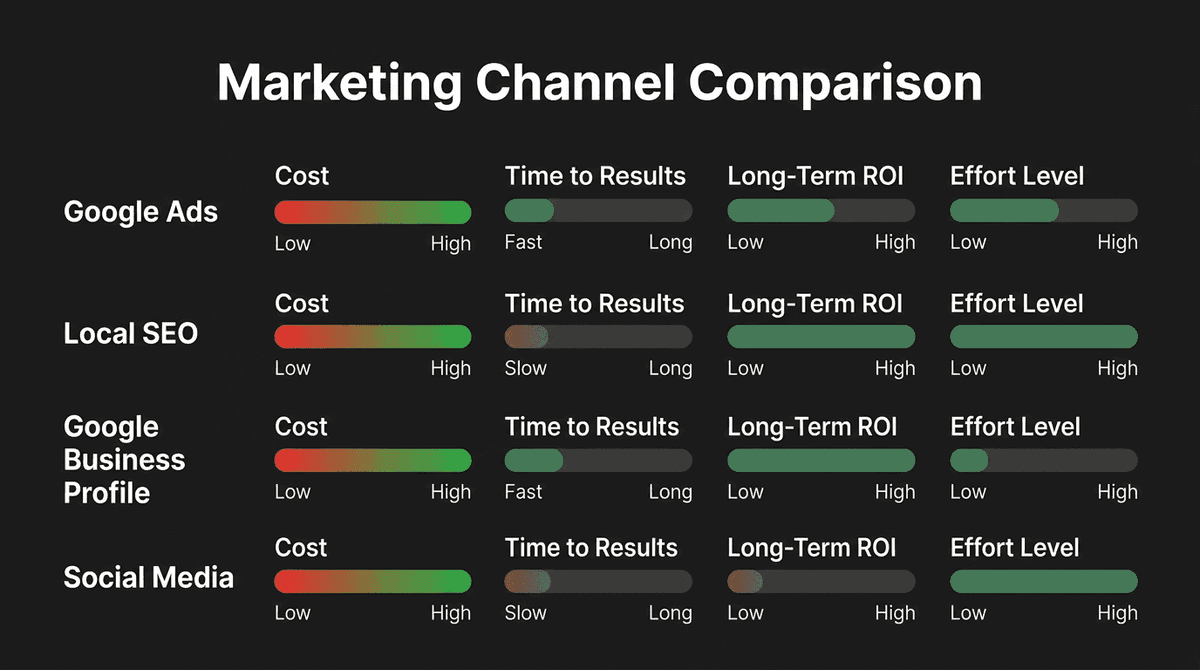
This guide covers every major digital marketing channel available to home service contractors — HVAC companies, roofers, plumbers, and electrical contractors — with honest benchmarks, channel tradeoffs, a channel comparison table, and a 12-month execution plan. If you want to go deeper on a specific trade, the vertical-specific articles linked throughout will take you there.
1) The Digital Marketing Landscape for Contractors
The home services market is one of the most intensely competitive categories in local search. Google has steadily claimed more real estate at the top of search results — Local Services Ads, Google Map Pack, and standard Search Ads now occupy the entire visible area above the fold on most mobile screens. Organic rankings, once the primary traffic source for contractor websites, now appear below three layers of paid placement.
This doesn't mean organic SEO is dead — far from it. It means the modern contractor marketing strategy needs to operate across multiple layers simultaneously. Paid search generates immediate leads. Local SEO builds the long-term asset. Your website converts both into calls. Your reputation sustains the conversion rate. Each channel reinforces the others, and the contractors who master all of them create a lead generation machine that compounds over time.
The biggest mistake contractors make is single-channel dependence. Running only Google Ads leaves you exposed to rising CPCs and account disruptions. Relying only on SEO means weathering 6–12 months of slow growth with no paid backstop. Word-of-mouth-only businesses plateau when referral networks stop growing. A diversified approach — even if each channel is modest — produces more stable, predictable lead flow than any single channel at maximum spend.
| Channel | Time to First Lead | Monthly Cost Range | Lead Quality | Ongoing Effort | |
|---|---|---|---|---|---|
| Google Business Profile | Immediate (if optimized) | Free | Very High | Low (maintenance) | |
| Google Ads (Search) | 1–3 days | $1,500–$6,000 | High | High (management) | |
| Local Services Ads | 2–4 weeks | $500–$2,500 | High | Medium | |
| Local SEO | 3–6 months | $800–$3,000 | Very High | Medium (content) | |
| Social Media Ads | 3–7 days | $500–$2,000 | Medium | High (creative) | |
| Email / CRM | Immediate (existing list) | $50–$300 | High (warm) | Low | |
| Referral Program | 30–60 days to build | $100–$300 | Very High | Low |
The Contractor Marketing Hierarchy
2) Your Website: The Foundation
Every digital marketing dollar you spend ultimately sends traffic to your website. Google Ads clicks, organic search visits, GBP link clicks, social media traffic — they all land on your site and either convert or don't. A poorly converting website is a tax on every other marketing channel you run. Before increasing any ad budget, fix your website.
The average contractor website converts 2–4% of visitors into leads. High-performing contractor sites convert 6–10%. The difference is almost never design — it's structure, speed, and trust signals. Homeowners who land on your site have already decided they need your service; your job is to make it as easy as possible to contact you and give them enough credibility signals to choose you over a competitor.
Contractor Website Conversion Checklist
- Phone number in the top navigation bar — tap-to-call on mobile, always visible on desktop. This is the single highest-impact conversion element on a contractor site.
- Hero section with a clear headline and CTA — "Licensed HVAC Contractor Serving [City] — Call for a Free Estimate" outperforms generic headlines by 30–60% in A/B tests across contractor verticals.
- Google review widget above the fold — displaying your star rating and review count on the homepage reduces hesitation and increases call rates by an estimated 15–25%.
- Trust signals in the hero section — license number, years in business, insurance status, and any certifications. Homeowners actively look for these before calling.
- Service-specific landing pages — each major service you offer deserves its own page with dedicated content, a localized headline, and a specific CTA. These pages rank for service + location keywords and convert significantly better than generic service lists.
- Mobile page speed under 3 seconds — over 65% of contractor searches happen on mobile. Slow sites lose leads before visitors see a single trust signal. Check your score at Google PageSpeed Insights and target 80+ on mobile.
- Simple lead form — 5 fields maximum — name, phone, email, service type, and message. Every additional field reduces form submissions. Add a honeypot field for spam prevention.
- 24/7 or emergency service badge — if you offer it, say so prominently. For HVAC, plumbing, and electrical, emergency availability is a decisive factor for a large percentage of inbound calls.
Template Websites Cost More Than They Save
3) Google Ads & Paid Search
Google Search Ads are the fastest path to exclusive, high-intent contractor leads. When a homeowner searches "HVAC repair near me," "emergency plumber [city]," or "roof replacement cost," Search Ads place your business at the top of the results page above everything else — organic listings, the Map Pack, and competitor websites. You pay only when someone clicks.
The economics vary by trade. Plumbing emergency keywords run $15–$35 per click in most markets. HVAC replacement keywords run $20–$50. Roofing keywords are among the most expensive in home services at $25–$60 per click, driven by the high average job value. But a $3,000 roof job or a $6,000 HVAC replacement makes even $50-per-click traffic profitable at a reasonable conversion rate. The key is building campaigns that spend on the right keywords and minimize wasted clicks. Our Google Ads management service is built specifically for home service contractors.
Google Ads Campaign Structure for Contractors
Separate Campaigns by Service Type
Emergency repair, standard service, and high-value installation/replacement keywords have different CPCs, different conversion rates, and different margins. Separating them lets you control budget, bids, and messaging independently. Mixing them into a single campaign forces Google to optimize toward the average, which typically means overspending on lower-margin work.
Build a Negative Keyword List Before Launch
Without negatives, 30–40% of contractor ad budgets typically go to clicks that will never convert: 'DIY how to,' 'jobs hiring,' 'cost to become a,' 'tools,' 'supply store,' 'free.' Build a 150+ negative keyword list before launching any campaign. Review the search terms report weekly for the first 90 days to capture additional negatives — every keyword you exclude improves your cost per lead.
Evaluate Local Services Ads as a First Layer
Local Services Ads (LSAs) appear above standard Search Ads and carry a Google Guaranteed badge — a powerful trust signal for home service contractors. LSAs are pay-per-lead rather than pay-per-click, with lead costs typically running $20–$80 depending on trade and market. They require less management than standard Search campaigns and are an ideal starting point for contractors new to paid advertising.
Match Ad Copy to Service-Specific Landing Pages
An ad for 'AC repair Tampa' should send traffic to a page specifically about AC repair in Tampa — not your generic homepage. Message match between ad and landing page is the single biggest driver of Quality Score, which directly reduces your CPC and improves ad position. Building dedicated landing pages for your top 5–10 keyword groups typically reduces cost per lead by 20–35%.
Use Call-Only Ads for Emergency Traffic
For high-urgency queries — 'no heat,' 'burst pipe,' 'power out' — call-only ad formats that route directly to your phone outperform standard ads. Homeowners with an emergency are not filling out a form. They need to speak to someone immediately. Call-only ads eliminate every click between the search and the call, and they tend to produce higher close rates than form submissions.
| Metric | HVAC | Roofing | Plumbing | Electrical | |
|---|---|---|---|---|---|
| Avg. CPC (high-intent) | $8–$25 | $15–$40 | $8–$20 | $8–$15 | |
| Avg. cost per lead | $30–$80 | $60–$150 | $25–$65 | $25–$75 | |
| Avg. job value | $300–$8,000 | $5,000–$25,000 | $200–$5,000 | $200–$10,000 | |
| Lead-to-close rate | 30–50% | 20–35% | 40–60% | 35–55% | |
| Min. monthly ad spend | $2,500 | $3,000 | $1,500 | $1,500 |
Track Revenue, Not Just Leads
4) Local SEO Strategy
Local SEO is the long-game that makes every other marketing channel cheaper. A contractor ranking organically for "HVAC company [city]" or "plumber near me" receives leads at zero marginal cost per click. After 12–24 months of consistent SEO investment, the cost per organic lead is typically 70–85% lower than the equivalent paid traffic. That's not a channel to de-prioritize — it's the most valuable asset in contractor marketing.
Local SEO for contractors operates across three interconnected layers: Google Business Profile signals (the primary driver of Map Pack rankings), on-page website optimization (the foundation of organic rankings), and off-page authority (citations, backlinks, and local signals that establish geographic credibility). All three need to improve in parallel — neglecting any one layer caps your results in the other two.
Google Business Profile: The Map Pack Engine
For most contractors, the Google Map Pack is the highest-value SEO real estate available. The three businesses that appear in the Map Pack for "[trade] near me" typically receive 60–70% of all clicks on that page. GBP optimization is free, and the results are measurable within 30–60 days of consistent effort — faster than almost any other SEO investment.
Complete Every Profile Field
Business name, address, service area (list every city and zip you serve), hours including emergency hours, phone, website, and a keyword-rich business description. Incomplete profiles rank meaningfully lower. Your business description should include your primary service, city, license number, and years in business in the first two sentences.
Optimize Category Selection
Your primary category is the single most important ranking factor in GBP. Select the most specific category available for your primary service: 'HVAC Contractor' rather than 'General Contractor,' 'Roofing Contractor' rather than 'Construction Company.' Then add every relevant secondary category for services you offer. Each category expands the search queries you can rank for.
Generate Reviews Systematically
Review velocity — how consistently you receive new reviews — is the most powerful Map Pack ranking signal you can control. A contractor who receives 5–10 new reviews per month will consistently outrank a competitor with 200 total reviews and zero new ones in the past 6 months. Build a post-job review request sequence and make it part of your technician workflow.
Post Weekly, Respond to Everything
GBP posts signal to Google that your profile is active and current. Post at minimum once per week — project highlights, seasonal promotions, or local tips. Respond to every review (positive and negative) within 24 hours. Both behaviors are correlated with higher Map Pack rankings and directly influence homeowner decision-making when they view your profile.
Service + Location Pages: The Organic Ranking Foundation
Dedicated service + location pages are the backbone of contractor organic SEO. A page titled "HVAC Repair in Tampa, FL" targeting the keyword "HVAC repair Tampa" can rank on page one within 3–6 months in most markets with the right on-page optimization and a few local backlinks. Build these pages for every major service you offer and every market you serve — even if that means 20–30 pages initially. Vertical-specific SEO guides: roofing SEO, electrician marketing, and plumbing advertising.
On-Page Optimization
Title tag, H1, meta description, and URL all containing the target keyword. 600+ words of original content answering the homeowner's questions about that service in that city. Schema markup for LocalBusiness and Service. Internal links to related service pages.
Citation Building
Consistent NAP (name, address, phone) across Yelp, Angi, HomeAdvisor, BBB, Houzz, and 30+ additional directories. Inconsistencies between citations actively suppress local rankings. Citation consistency is hygiene work, not glamorous — but it's foundational and every contractor needs it.
Local Link Building
Backlinks from local chambers of commerce, supplier directories, trade associations, and local news sites carry significant local SEO weight. Each local link is a geographic authority signal — they tell Google not just that you're relevant but that you're relevant in a specific location.
Thin Content Pages Hurt More Than Help
5) Reputation Management
Online reputation is no longer a soft metric — it's a direct lead generation lever. A contractor with 150 Google reviews at 4.8 stars will consistently out-convert a competitor with 20 reviews at 4.9 stars, because volume signals longevity and social proof at a scale that a perfect-but-sparse rating cannot match. Homeowners have been burned by contractors; they read reviews before calling, and they pay close attention to review recency, volume, and how the owner responds.
The contractors who dominate local markets on reputation didn't get there by doing better work — most contractors do good work. They got there by systematically asking for reviews after every completed job. The research is consistent: 68% of consumers will leave a review when asked directly, but fewer than 15% will do so spontaneously. The review gap between market leaders and everyone else is almost entirely explained by who has a system and who doesn't.
The Contractor Review Generation System
Three-Touch Post-Job Review Sequence
- Touch 1 — At job completion (in person): The technician or owner verbally asks: "We'd really appreciate it if you took 60 seconds to leave us a Google review — I can text you a direct link right now." In-person requests have the highest conversion rate of any review ask format.
- Touch 2 — Within 2 hours (SMS): Send the direct GBP review link via text. Keep it personal and short: "Hi [Name], this is [Tech] from [Company]. Here's the Google review link I mentioned — [link]. It really helps us out. Thank you!"
- Touch 3 — 3 days later (email, if no review): One follow-up email only. Beyond two total asks, you risk turning appreciation into pressure. If they haven't reviewed after two requests, let it go and focus on the next job.
Responding to Negative Reviews
Every contractor gets negative reviews eventually. How you respond is visible to every homeowner who reads it — and it signals far more about your business character than the negative review itself. A defensive or dismissive response to a 1-star review pushes prospects away. A professional, empathetic response to the same review often converts skeptical readers into callers. Respond to all negative reviews within 24 hours, acknowledge the concern specifically, offer to resolve it offline, and keep the response under 75 words.
What Not to Do
- Argue with the reviewer publicly about facts
- Accuse the reviewer of dishonesty or bad faith
- Write a defensive 300-word essay explaining your side
- Ignore negative reviews and hope they go away
- Offer incentives for removing negative reviews (against Google policy)
What Works
- Respond within 24 hours — always
- Thank the reviewer for their feedback
- Acknowledge the specific concern without excuses
- Offer a direct path to resolution: "Please call [phone]"
- Keep it under 75 words — short responses look confident
Reputation Management Tools Worth Using
7) Email & CRM
Most contractors have a goldmine sitting unused: their existing customer list. A homeowner who has already hired you — and had a good experience — is dramatically more likely to hire you again and to refer you to neighbors than any cold prospect. Email marketing to your existing customer base generates leads at nearly zero marginal cost and produces some of the highest conversion rates of any channel available to contractors.
The problem is that most contractors don't have a systematic way to stay in front of past customers. Jobs get completed, names go into an invoice system, and that's the end of the relationship — until the homeowner has another need and searches Google again, where they might find you or might find a competitor. A simple CRM and quarterly email cadence can recover a significant portion of that lost repeat business.
Contractor Email Marketing Fundamentals
Build Your Customer List From Day One
Every completed job should capture the customer's name, phone, email, address, service performed, and date. This is the foundation of your CRM. If you're starting from scratch, import past invoice records into a simple CRM like ServiceTitan, Jobber, or HousecallPro. Even a clean spreadsheet segmented by service type and job date is better than no list at all.
Seasonal Maintenance Campaigns
Seasonal reminder emails are the highest-ROI email type for contractors. 'Time for your annual AC tune-up before summer' or 'Roof inspection season is here — book before the rush' sent to past customers generates a predictable wave of repeat bookings every season. These emails perform because they're not cold — the homeowner already knows and trusts you.
Review Request Automation
Integrate your CRM with your review request sequence so that every completed job automatically triggers a review request SMS and email. Tools like Jobber, ServiceTitan, and HousecallPro have this built in or integrate with Birdeye and Podium. Automated review requests add 5–15 reviews per month for most contractors without any additional manual effort.
Service Anniversary Reminders
If you replace an HVAC system in June 2025, send a service anniversary email in May 2026 — "It's been a year since your new system install. Time for a tune-up to keep it running at peak efficiency." These emails have open rates of 40–60% (vs. 20–25% for standard marketing emails) because they're highly relevant and expected by the recipient.
A $50/Month CRM Beats a $0 Spreadsheet in Three Months
8) Marketing Budget Planning
The industry benchmark for contractor marketing investment is 5–10% of annual revenue. A $500K contractor should budget $25,000–$50,000 per year — roughly $2,100–$4,200 per month. A $1M contractor should budget $50,000–$100,000 per year. These are not arbitrary figures; they reflect what it actually costs to maintain competitive visibility across the channels that drive home service leads in 2025.
The right allocation depends on your growth stage. Early-stage contractors with no organic presence should weight heavily toward Google Ads and LSAs — channels that generate leads immediately while SEO is being built. Established contractors with strong organic rankings can shift budget toward SEO maintenance and reputation management while reducing paid reliance. The goal at every stage is to be moving toward a channel mix where organic and referral leads offset a growing portion of paid spend.
Recommended Channel Allocation by Business Stage
| Channel | New Business (0–2 yrs) | Growing (2–5 yrs) | Established (5+ yrs) | |
|---|---|---|---|---|
| Google Ads / LSAs | 45–55% | 35–45% | 25–35% | |
| Local SEO | 20–25% | 25–35% | 30–40% | |
| Website Development & Maintenance | 15–20% | 10–15% | 10–15% | |
| Reputation Management Tools | 5–10% | 10–15% | 10–15% | |
| Social Ads | 0–5% | 5–10% | 5–10% | |
| Email / CRM | 0–5% | 5% | 5% |
These allocations are starting points. The right mix for your business depends on your current organic rankings, your market competition, your average job value, and your close rate by channel. Measure cost per booked job — not just cost per lead — for each channel every month. Budget should follow performance: shift spend toward whatever produces booked jobs at the lowest cost, and reduce spend on channels that produce unbooked leads.
12-Month Contractor Marketing Timeline
Month 1–2: Foundation Audit and Infrastructure
Months 1–2Audit your GBP, website, and existing reviews. Fix technical SEO issues — page speed, schema markup, NAP consistency across directories. Set up call tracking on your website. Install the Facebook Pixel. Select and configure a CRM. This infrastructure work determines the ROI of everything that follows.
Month 2–3: Launch Paid Campaigns
Months 2–3Launch Local Services Ads if you qualify for your trade and state. Launch Google Search Ads with tightly structured campaigns, a robust negative keyword list, and service-specific landing pages. Set up conversion tracking for calls and form fills. Plan to spend at minimum $1,500–$2,500/month to generate enough data for meaningful optimization.
Month 3–4: Build SEO Content Foundation
Months 3–4Publish service + location pages for your top 5–10 keyword targets. Each page should be 600+ words with original content, proper schema markup, and internal links. Build or clean up citations across the top 30 local directories. Start the GBP post cadence — weekly posts about projects, seasonal tips, or limited offers.
Month 4–6: Reputation Engine Launch
Months 4–6Implement the post-job review request sequence with your CRM or a dedicated reputation tool. The goal is 8–15 new Google reviews per month. Respond to every review within 24 hours. By month 6, the combination of new reviews and GBP post activity should produce visible Map Pack ranking improvements for your primary service area.
Month 6–9: SEO Momentum and Paid Optimization
Months 6–9Early organic rankings start appearing for service + location pages. Publish 2–4 additional location or service pages per month to expand keyword coverage. Optimize Google Ads based on 90+ days of conversion data — pause underperforming ad groups, increase bids on top performers, add new high-intent keywords discovered in the search terms report.
Month 9–12: Channel Integration and Scaling
Months 9–12By month 9, you should have data across all primary channels. Analyze cost per booked job by channel and reallocate budget toward best performers. Add social retargeting for website visitors who didn't convert. Launch seasonal email campaigns to your growing customer list. Plan next year's budget based on channel performance data rather than assumptions.
5–10%
Of revenue to invest in marketing for consistent growth
3–5x
ROI target for every dollar invested in paid channels
6–12 mo
Time for a full multi-channel strategy to reach full velocity
70–85%
Lower cost per lead from organic vs. paid traffic (long-term)
Diversification Is Risk Management
Frequently Asked Questions
How much should a contractor spend on digital marketing?
Most successful contractors invest 5-10% of revenue in marketing. A $1M company should budget $50K-$100K annually. Allocate roughly 40% to Google Ads, 30% to SEO, 15% to website, and 15% to reputation management and other channels.
What is the best marketing strategy for home service contractors?
The most effective strategy combines Google Ads for immediate leads, local SEO for long-term organic traffic, and a conversion-optimized website. Add active review management and you have a complete system. Single-channel approaches are fragile — diversification is key.
How long does digital marketing take to work for contractors?
Google Ads generate leads within days. Local SEO improvements show in 2-4 months. Full organic SEO results take 4-8 months. The best results come from 6-12 months of consistent effort across all channels, when paid and organic work together.
The Bottom Line
Contractor digital marketing is not complicated — it's just layered. The contractors who dominate their local markets aren't running exotic strategies. They have a fast website that converts, a Google Business Profile that ranks, a Google Ads account that spends efficiently, a review program that runs on autopilot, and a growing base of organic traffic that gets cheaper every month. Execute those five things consistently and you will outperform 80% of your market within 12 months.
The single biggest mistake is waiting until the slow season to start. Every month without a functioning SEO strategy is a month of organic rankings you can't recover. Every month without a review system is reviews you'll never recapture. Every month without call tracking is data you can't use to optimize your ad spend. The best time to start was six months ago. The second best time is now.
If you want a specific, prioritized roadmap for your business — based on your actual current website, GBP, and competitive landscape — start with a free audit. You'll know exactly where you stand and what to fix first within 24 hours.
For trade-specific depth, explore our vertical guides: HVAC marketing, roofing marketing, plumbing marketing, and electrical contractor marketing. For managed services, see our Google Ads management, local SEO service, and contractor website development.
6) Social Media for Contractors
Social media is often the first place contractors invest marketing budget and the first place they abandon it. The issue is misaligned expectations: social media — particularly organic posting — rarely generates direct leads for home service contractors. Homeowners don't open Instagram thinking "I should find an HVAC company to follow." The value of social media for contractors lies elsewhere: paid advertising that interrupts homeowners before they have an immediate need, and social proof that supports conversion when they do.
Facebook and Instagram ads are the most effective social channels for contractors. The targeting options — homeowners, home value ranges, specific zip codes, recent move-ins — allow contractors to reach the exact demographic most likely to hire them. Facebook ads for home services typically generate leads at $30–$80 each for service campaigns and $50–$150 for higher-value installation campaigns. That's generally higher cost-per-lead than Google Ads, but social ads reach homeowners who aren't actively searching — expanding the addressable market beyond in-market searchers.
What Actually Works on Social for Contractors
Before-and-After Project Photos
Before-and-after posts consistently generate the highest organic engagement for contractors. A roofing replacement, a panel upgrade, a new HVAC install — the visual transformation is compelling. These posts also build the portfolio of work that homeowners browse when evaluating whether to call. Post project photos with a short description and your service area mentioned.
Facebook Lead Gen Ads With Seasonal Offers
Facebook lead generation ad campaigns — where the lead form opens directly in Facebook without a website visit — work well for seasonal offers. 'Free AC tune-up with any service call this month' or 'Free roof inspection — book this week' drive lead form submissions at lower CPLs than standard website traffic campaigns. These leads tend to be earlier in the buying cycle, so follow-up speed matters.
Retargeting Website Visitors
Install the Facebook Pixel on your website and retarget visitors who came from Google Ads or organic search but didn't convert. A homeowner who searched 'roof replacement Tampa,' clicked your ad, browsed your site, and left without calling is still a warm prospect — retargeting them on Facebook with a testimonial ad or a limited-time offer often converts them on a second touch. Retargeting CPLs are typically 40–60% lower than prospecting campaigns.
Google Business Profile Posts Are Social Media Too
GBP posts function like social media posts for local search — they appear in your Knowledge Panel, in Maps, and sometimes in local search results. Unlike Facebook or Instagram, GBP posts reach homeowners at the exact moment they're evaluating contractors. Weekly posts about recent projects, seasonal tips, or limited offers take 15 minutes and directly support Map Pack rankings.
Don't Chase TikTok or YouTube Unless You Have the Time