46%
Of all Google searches have local intent — plumbing is near the top
3-Pack
Map Pack captures 44% of clicks on local plumbing searches
$65
Average cost per plumbing lead from paid ads — SEO cuts this to under $20 long-term
2–4mo
Typical time to see Map Pack ranking improvements from GBP optimization
When a homeowner's toilet backs up at 9 PM or a pipe bursts on a Sunday morning, they reach for their phone and search "plumber near me." What appears in those first three Map Pack results gets the call. Everything below that — other plumbers, page-2 results, directory listings — gets ignored. Local SEO for plumbers is the discipline of making sure your company occupies that top real estate.
Plumbing is one of the most intent-driven local service categories online. The searches are high-urgency, the tickets are substantial (drain cleaning at $150, water heater replacement at $1,200+, repiping at $4,000–$15,000), and the window between search and hire is minutes, not days. If you're not in the Map Pack, you're invisible when it counts most.
This guide walks through every component of local SEO for plumbing companies — from Google Business Profile setup to service area pages, citation building, review systems, and on-page optimization. Work through it systematically and you'll have a clear action plan for dominating your market. For a full view of plumbing marketing beyond SEO, see our plumbing industry marketing guide.
1) Why Local SEO Matters for Plumbers
Paid advertising — Google Ads, Local Services Ads — delivers leads the moment your campaign goes live. But it stops the moment you pause your budget. Local SEO is the opposite: the rankings you build today keep generating calls for months and years, with no marginal cost per lead. For plumbing companies with predictable service demand, the compounding return is enormous.
Consider what Map Pack visibility is worth to a plumbing company. If a top-three listing generates 30 calls per month and you close 40% of them at an average ticket of $350, that's $4,200 in monthly revenue from a single channel — before counting the upsells, repeat customers, and referrals each job produces. Scale that over 12 months and you're looking at $50,000+ in annual revenue from organic search alone.
| Google Ads / LSAs | Local SEO | |
|---|---|---|
| Lead cost (avg) | $45–$90 per lead | $10–$25 per lead (long-term) |
| Time to first lead | 1–3 days | 2–6 months |
| Stops when you... | Pause budget | Stop optimizing/building |
| Visibility type | Labeled "Sponsored" or "Ad" | Earned organic placement |
| Scalability | Linear with budget | Compounds over time |
| Competition | Auction-based, rising CPC | Content and authority-based |
Run Both While SEO Builds
The smartest plumbing companies run Google Ads or Local Services Ads immediately while their local SEO builds momentum. Use paid traffic to keep your schedule full in months 1–4. Once organic rankings deliver consistent lead flow, reduce ad spend or reinvest it into growth. The two channels are complementary, not competing.
Plumbing also benefits from two distinct search intent categories: emergency searches ("emergency plumber near me," "burst pipe repair") and planned-service searches ("water heater replacement cost," "drain cleaning service"). Local SEO captures both. Emergency searches favor Map Pack listings — homeowners call the first result they see. Planned searches favor organic rankings and blog content. A complete local SEO strategy covers both.
2) Google Business Profile Optimization
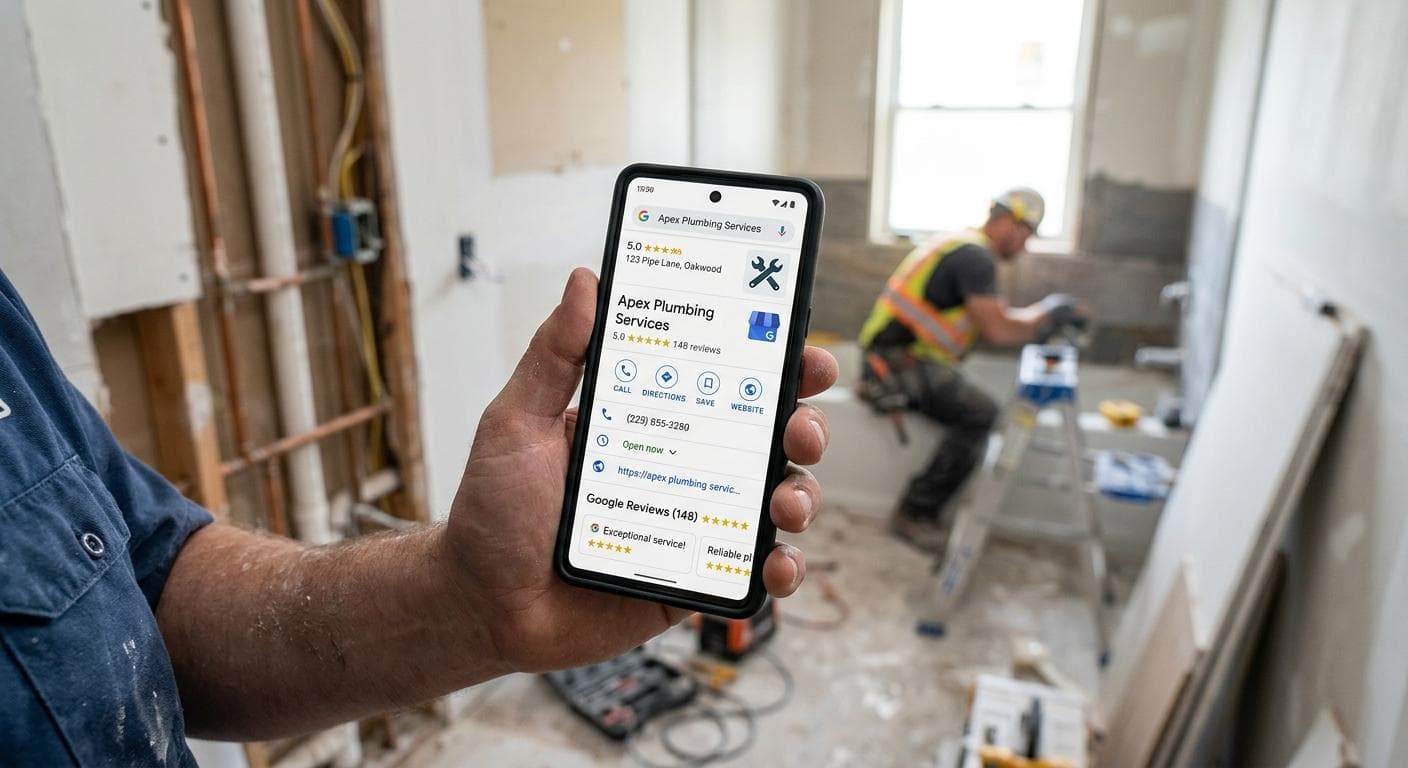
Your Google Business Profile (GBP) is the single most important local SEO asset you control. It is what appears in the Map Pack — the three-listing block that dominates local search results. An incomplete, inaccurate, or poorly optimized profile is the most common reason plumbing companies don't appear in the top three, even when they have good websites.
GBP optimization for plumbers is not a one-time task. It's an ongoing process of keeping your profile complete, adding new photos, publishing posts, and building reviews. Google rewards actively managed profiles with higher visibility. Here's how to set yours up for maximum Map Pack performance.
Claim and Verify Your Profile
Go to business.google.com and claim your listing if you haven't already. If a listing exists but you don't control it, request ownership. Verification is typically done by postcard (sent to your business address), phone, or email. Until your profile is verified, it won't rank.
Set the Right Primary Category
Your primary category is the strongest ranking signal in your GBP. Set it to 'Plumber' — not 'Contractor' or 'Home Services.' Add secondary categories for specific services: 'Water Heater Installation Service,' 'Drainage Service,' 'Septic System Service,' 'Gas Installation Service.' Each additional relevant category expands the search queries you can rank for.
Complete Every Profile Field
Business name (exactly as it appears on your license), address (physical location — not a PO box), phone number (your primary local number), website URL, business hours (including holiday hours), and service area. Use the service area feature to list every city, town, and zip code you serve. Be comprehensive — if you don't list a city, you may not appear for searches there.
Write a Keyword-Rich Business Description
You have 750 characters. Use them to describe what you do and where: your primary services (drain cleaning, water heater repair/replacement, leak detection, sewer line repair), your service cities, your years in business, and any differentiators (24/7 emergency service, licensed and insured, upfront pricing). Include your primary keyword naturally: 'plumber in [city],' 'plumbing company [city].'
Build Out the Services Section
GBP lets you list individual services with names, descriptions, and prices (optional). Add every service you offer: drain cleaning, water heater installation, toilet repair, pipe repair, sewer line inspection, leak detection, bathroom remodeling, gas line services. Each service description is indexed by Google — this is prime keyword real estate most plumbers leave empty.
Upload Photos Consistently
Google prioritizes profiles with recent, high-quality photos. Upload at least 20 photos to start: job photos (before/after drain cleaning, water heater installs, pipe repairs), team photos, vehicle photos, and office/shop photos. Add 2–4 new photos every week. Geo-tagged images (photos taken on a phone with location services enabled) can reinforce your service area signals.
Post Weekly to Your GBP
GBP Posts are short updates that appear on your profile. Publish one per week: completed jobs ('Just finished a water heater replacement in [neighborhood]'), seasonal tips ('Prevent frozen pipes this winter — call us for pipe insulation'), promotions, or answers to common questions. Regular posting signals to Google that your profile is actively managed.
Seed Your Q&A Section
Anyone can ask — and answer — questions on your GBP. Don't leave this to chance. Log in and add the questions homeowners actually ask: "Do you offer free estimates?" "Are you available for emergencies?" "Do you service [specific city]?" "What brands of water heaters do you install?" Answer them yourself. This content appears on your profile and is indexed by Google.
3) Local Keyword Strategy
Local keyword strategy for plumbers is about identifying the exact phrases homeowners type when they need a plumber — and mapping each phrase to the right page on your website. Get this right, and Google knows exactly which searches to send your way. Get it wrong, and your pages compete against each other or rank for nothing.
High-Value Plumbing Keywords
| Monthly Searches | Intent | Best Page | |
|---|---|---|---|
| plumber near me | 74,000 | Emergency/Purchase | Homepage |
| emergency plumber [city] | 1,000–4,400 | Emergency | Homepage or emergency page |
| plumbing company [city] | 500–2,900 | Purchase | Homepage or location page |
| drain cleaning [city] | 200–1,600 | Purchase | Drain cleaning service page |
| water heater replacement [city] | 300–1,900 | Purchase | Water heater service page |
| leak detection [city] | 100–800 | Purchase | Leak detection service page |
| sewer line repair [city] | 100–600 | Purchase | Sewer service page |
| water heater repair cost | 8,100 | Research | Blog article |
| how to unclog a drain | 22,200 | Research | Blog article |
Notice the split: "plumber near me" and service-plus-city keywords belong on your service and location pages. Research-intent keywords ("water heater repair cost," "how to unclog a drain") belong on blog articles. Someone searching how to unclog their own drain may eventually call a plumber — your article positions you as the expert they trust when that moment arrives.
Emergency vs. Planned Service Keywords
Plumbing keyword research should account for the urgency dimension. Emergency keywords convert at much higher rates because the searcher has an immediate need and no time to comparison shop. Planned-service keywords are more competitive and research-oriented — the homeowner is evaluating options.
Emergency Keywords (High Urgency)
- • "emergency plumber [city]"
- • "24 hour plumber [city]"
- • "burst pipe repair near me"
- • "plumber open now [city]"
- • "water leak repair emergency"
- • "flooded basement plumber"
Planned Service Keywords (Research Phase)
- • "water heater replacement [city]"
- • "drain cleaning service [city]"
- • "bathroom remodel plumber [city]"
- • "whole house repiping cost"
- • "sewer line inspection [city]"
- • "water softener installation [city]"
Long-Tail Keywords Win Faster
"Plumber near me" is searched 74,000 times per month — and every plumbing company in your market is targeting it. "Emergency water heater repair [your city]" is searched 200 times per month and has a fraction of the competition. Long-tail, service-specific, city-specific keywords are where newer or smaller plumbing companies should focus first. Rank for 20 long-tail terms and you'll outperform competitors chasing broad keywords they can't win.
One Keyword Per Page
Targeting "drain cleaning [city]" and "sewer cleaning [city]" on the same page dilutes your ranking potential for both. Build a dedicated page for each major service. Google can only rank one page per domain for a given keyword — give it a clear, dedicated page to work with for each target keyword.
4) Creating Service Area Pages
Service area pages are dedicated website pages targeting specific cities or neighborhoods within your service area. If you serve Tampa, St. Petersburg, Clearwater, and Brandon, each city should have its own page — not a single "service area" page listing all four cities. Google cannot rank a single page for "plumber Tampa," "plumber St. Petersburg," and "plumber Clearwater" simultaneously. One page, one target keyword.
Service area pages are one of the highest-leverage SEO investments a plumbing company can make. Each page you build is a new ranking opportunity for a location-specific keyword — and location-specific keywords have buying intent baked in. Someone searching "plumber Brandon FL" is not browsing. They need a plumber in Brandon.
What a High-Quality Service Area Page Includes
Unique H1 and Title Tag
Original Location-Specific Content
Local Social Proof
Service List with Local Context
Local Phone Number
Schema Markup
Duplicate Content Kills Service Area Pages
The most common service area page mistake is creating 10 pages that are identical except for the city name. Google recognizes thin, duplicated content and will either not rank the pages or penalize the domain. Every service area page needs genuinely unique content. If you can't write original content for a city, prioritize the cities with the highest search volume and build fewer, better pages.
Service Area Page URL Structure
/plumber-tampa-fl
/plumber-st-petersburg-fl
/plumber-clearwater-fl
/drain-cleaning-tampa
/water-heater-replacement-brandon-fl
Include the primary service and city in the URL slug. Keep slugs short — under 5–6 words. Avoid dates or parameters in location page URLs.
5) Citations & Directory Listings
A local citation is any mention of your business name, address, and phone number (NAP) on a website other than your own. Citations are a foundational local SEO signal — they tell Google that your business exists at a specific physical location and has been recognized by third-party sources. The quantity, quality, and consistency of your citations directly affect Map Pack rankings.
For plumbing companies, citations fall into two categories: general business directories (Yelp, BBB, Google Maps) and plumbing-specific directories (Angi, HomeAdvisor, Thumbtack). Both matter. General directories have higher domain authority and broader reach. Plumbing-specific directories send higher-quality referral traffic and carry industry relevance signals that Google weighs in local rankings.
Priority Citation Sources for Plumbers
| Directory | Type | Why It Matters | |
|---|---|---|---|
| Google Business Profile | General | Foundation of Map Pack rankings — non-negotiable | |
| Yelp | General | High domain authority, strong consumer trust, referral traffic | |
| Angi (Angie's List) | Home Services | Industry-specific, homeowner intent, lead referrals | |
| HomeAdvisor | Home Services | High domain authority, plumbing category pages rank well | |
| BBB | General | Trust signal, strong domain authority, consumers check this | |
| Thumbtack | Home Services | Active local marketplace, sends referral leads | |
| Nextdoor Business | Local | Neighborhood-level visibility, high-trust platform | |
| Apple Maps | General | iOS users — a significant portion of mobile searches | |
| Bing Places | General | Bing and DuckDuckGo rankings — often ignored, easy win | |
| Chamber of Commerce | Local | Local backlink + citation — strong local authority signal |
NAP Consistency Is Non-Negotiable
Your business name, address, and phone number must be identical across every directory. If your GBP shows "ABC Plumbing LLC" but Yelp shows "ABC Plumbing" and Angi shows "ABC Plumbing Services," Google sees three different businesses. This inconsistency dilutes your citation authority and suppresses Map Pack rankings. Audit your citations with BrightLocal or Moz Local and fix every discrepancy before building new ones.
Building Citations Efficiently
Manual citation building is time-consuming but controllable. The fastest approach: use a service like BrightLocal or Whitespark to submit your NAP to 50–100 directories simultaneously. This costs $100–$300 as a one-time project and saves 10–20 hours of manual work. After the initial build, focus on maintaining accuracy rather than adding more directories — quality and consistency beat volume.
Plumber-Specific Directories to Prioritize
- • Angi (angi.com) — formerly Angie's List, strong consumer trust
- • HomeAdvisor (homeadvisor.com) — high domain authority, plumbing category pages
- • Porch (porch.com) — home improvement contractor directory
- • Houzz (houzz.com) — home improvement and remodel audience
- • Service Magic — feeds HomeAdvisor network
- • Plumbers.com — plumbing-specific directory, industry authority
6) Review Generation Strategy
Reviews are the most powerful and controllable local SEO signal for plumbing companies. Google uses review quantity, review recency, average star rating, and response rate as direct Map Pack ranking factors. Beyond rankings, reviews are the #1 trust signal homeowners use to choose between plumbers. A company with 200 reviews averaging 4.8 stars will win the call over a company with 15 reviews at 4.5 stars — every time.
Most plumbing companies ask for reviews inconsistently, if at all. The ones that dominate their local Map Pack have a systematic review generation process that runs automatically after every job. Here's how to build that system.
Create Your Review Request Link
In your Google Business Profile dashboard, click 'Ask for Reviews.' Copy the direct review link. This takes customers directly to the review box without extra navigation. Shorten it with a link shortener if needed for SMS.
Text Within 2 Hours of Job Completion
SMS review requests sent within 2 hours of job completion have a 30-40% conversion rate. The same request sent 24 hours later drops to under 10%. Your text should be brief and personal: 'Hi [Name], thanks for choosing [Company]! If you're happy with the service, a Google review would mean a lot to us: [link]. — [Tech name]'
Train Your Technicians to Ask Verbally
Before leaving every job, your tech should say: 'If you're satisfied with the work today, we'd really appreciate a Google review. I'll text you a link in a few minutes.' The verbal ask primes the customer to expect and act on the text. This simple habit doubles review conversion rates.
Follow Up Once by Email
If the customer doesn't leave a review within 48 hours, send one follow-up email. Keep it short, include the direct link, and make it easy to act. Don't follow up more than once — it becomes annoying and can generate negative sentiment.
Respond to Every Review Within 24 Hours
Respond to positive reviews with a brief, personalized thank-you. Respond to negative reviews professionally — acknowledge the issue, offer to resolve it, and take the conversation offline. Google tracks response rate and recency as ranking signals. A plumbing company that responds to all reviews ranks higher than one with more reviews but no responses.
Target 5 New Reviews Per Month Minimum
Review recency matters as much as total count. A competitor with 50 reviews all from 2023 will lose to a company with 30 reviews including 10 from the last 30 days. Google interprets recent reviews as evidence that the business is active and reputable. Aim for at least 5 new reviews per month — on a consistent basis — to maintain ranking momentum.
Never Buy or Fake Reviews
Purchased reviews, review pods, or reviews left by friends and family violate Google's terms of service. Google's detection algorithms are sophisticated — fake reviews are frequently removed and repeat violations can result in GBP suspension. A suspension removes your Map Pack listing entirely and takes weeks or months to resolve. The risk is not worth it when legitimate review generation is this straightforward.
7) On-Page SEO for Plumbing Sites
On-page SEO is the work you do on your own website — title tags, content, page structure, internal links, schema — to help Google understand what each page is about and which searches it should rank for. Even the best GBP and strongest citation profile won't fully compensate for a poorly optimized website. The two work together: your GBP drives Map Pack visibility, your website drives organic rankings and converts visitors into leads.
On-Page SEO Checklist for Plumbing Companies
- Title tags: Include primary keyword and city. Format: "Plumber in [City], [State] | [Company Name]" — under 60 characters
- Meta descriptions: 150–160 characters, include a CTA ("Call for same-day service" or "Free estimates available"), naturally include the primary keyword
- H1 tag: One per page, contains the primary keyword. Example: "Emergency Plumber in Tampa, FL — Available 24/7"
- H2 and H3 subheadings: Use keyword variations in subheadings. "Water Heater Repair in Tampa" and "Drain Cleaning Services" in H2 tags signal topical breadth
- Page content: 600–1,000 words minimum for service pages. Include the city name, service name, and related terms naturally throughout
- LocalBusiness schema: Add structured data to every page with your business name, address, phone, hours, service area, and price range
- NAP in footer: Name, address, and phone number in the site footer — must match your GBP exactly
- Mobile optimization: Over 75% of plumbing searches happen on mobile. Run Google's Mobile-Friendly Test and fix any issues
- Page speed: Target a Google PageSpeed Insights score above 70 on mobile. Slow pages hurt rankings and conversion rates equally
- Internal links: Link from service pages to relevant location pages and vice versa. Link to your contact page from every service page
- Clear CTAs on every page: Phone number in the header, a "Request Service" button above the fold, and a contact form or CTA at the bottom of every page
- Trust signals: License number, insurance badge, years in business, and review count prominently displayed — these improve conversion rates alongside SEO
Title Tag Formulas That Work for Plumbing
Homepage
"Plumber in [City], [State] | Licensed & Insured | [Company Name]"
Service Page
"Drain Cleaning in [City], [State] | [Company Name]"
Emergency Page
"Emergency Plumber in [City] — 24/7 Service | [Company Name]"
Location Page
"Plumbing Services in [City], [State] | [Company Name]"
The First 100 Words Do the Heavy Lifting
Google reads the beginning of your page content with more weight than the rest. The first sentence of every service page should state exactly what you do and where: "We provide professional drain cleaning services in [City], [State], with same-day appointments available for emergency clogs." This single sentence gives Google all the signals it needs to understand the page's relevance before reading another word.
For more detail on local SEO services for plumbing companies, including how we handle technical SEO, content creation, and monthly optimization, see our SEO service page. And if your website needs a rebuild before SEO makes sense, our contractor website development service builds SEO-ready plumbing websites designed to convert.
8) Measuring Your Local SEO Results
Local SEO without measurement is guesswork. You need to track the right metrics to understand what's working, where you're gaining ground, and whether your investment is generating a return. The core measurement tools are free — there's no excuse not to use them.
Essential Measurement Tools for Plumbers
| Tool | What It Tracks | Cost | |
|---|---|---|---|
| Google Search Console | Keyword rankings, impressions, clicks, indexing errors | Free | |
| Google Business Profile Insights | Map Pack impressions, direction requests, calls from GBP | Free | |
| Google Analytics 4 | Website traffic, lead form submissions, user behavior by source | Free | |
| BrightLocal | Local rank tracking, citation audits, review monitoring | $29–$49/mo | |
| CallRail | Call tracking — which pages and keywords generate phone calls | $45–$95/mo | |
| Ahrefs / SEMrush | Keyword rank tracking, competitor gap analysis, backlink monitoring | $100–$200/mo |
KPIs to Track Monthly
- GBP impressions: How often your listing appeared in Google Search and Maps. Should grow month over month as you optimize and build reviews
- GBP calls: Calls initiated directly from your Google Business Profile listing. This is the most direct measure of Map Pack ROI
- GBP direction requests: Homeowners requesting directions to your business — a strong intent signal for service area expansion
- Organic sessions: Website visits from non-paid search. Track overall trend and growth month-over-month
- Keyword rankings: Track your 10–20 highest-priority keywords. Are target service and location keywords moving up?
- Organic leads: Form fills and tracked calls from organic search in GA4 and CallRail. The ultimate metric
- Review count and rating: Total GBP reviews and average star rating. Track new reviews per month
- Cost per organic lead: Total SEO spend ÷ organic leads generated. Benchmark against your paid lead costs
Realistic Local SEO Timeline for Plumbers
Local SEO results are not linear, but there is a predictable pattern:
Weeks 1–4: Foundation
GBP fully optimized, citations submitted, on-page fixes implemented. GBP impressions begin increasing within 2–4 weeks of GBP optimization.
Months 2–3: Early Signals
Keyword rankings begin to move. GBP calls increasing. New service area pages begin picking up impressions in Search Console. Review count growing.
Months 4–6: Meaningful Lead Flow
Consistent Map Pack visibility for primary city keywords. Organic leads become a measurable channel. ROI calculation becomes clear.
Months 6–12: Compounding Returns
Organic search becomes a reliable, growing lead source. Cost per lead declining month over month. Competitive positions stable and expanding to secondary cities.
Set a 6-Month Benchmark
After six months of consistent local SEO execution, you should rank in the top 3 of the Map Pack for your primary city + "plumber" keyword, and your GBP should be generating at least 20–40 calls or direction requests per month. If you're not there, audit the three most common gaps: weak GBP (missing content, few photos, low reviews), inconsistent NAP (citation errors), and thin website content (no dedicated service or location pages).
For plumbers who want to accelerate results with paid advertising alongside SEO, see our related articles on plumbing advertising channels and Google Ads for plumbers. For generating more inbound leads across all channels, see our guide to plumbing lead generation.
Frequently Asked Questions
How long does local SEO take for plumbers?
Google Business Profile optimizations can show results in 2-4 weeks. Map Pack ranking improvements typically take 2-4 months. Full local SEO results including organic rankings take 4-8 months. Emergency plumbing keywords are highly competitive and may take longer.
How much does SEO cost for a plumbing company?
Professional local SEO for plumbers costs $1,000-$2,500/month. This should include GBP optimization, citation building, review management, content creation, and on-page optimization. Enterprise plumbing companies with multiple locations may need $3,000-$5,000/month.
Can plumbers do SEO themselves?
Plumbers can handle basic SEO: claiming and optimizing their Google Business Profile, asking for reviews, and posting photos. However, technical SEO, content strategy, and link building require expertise. Most plumbers get the best ROI by handling GBP themselves and hiring a professional for the rest.
The Bottom Line
Local SEO for plumbers is not complicated — but it does require consistency. Optimize your Google Business Profile completely and keep it active with photos, posts, and Q&A. Build a systematic review process and get 5+ new reviews every month. Fix NAP inconsistencies across your citation profile. Create dedicated service and location pages with original, keyword-targeted content. Nail your title tags and on-page structure. Track GBP calls and organic leads every month.
Each of these steps is achievable. The plumbing companies that dominate their local Map Pack are not doing anything exotic — they're executing these fundamentals more consistently than their competitors. The barrier is time and attention, not technical knowledge.
If you want to know exactly where your plumbing website stands right now — what's working, what's holding back your Map Pack rankings, and what to fix first — start with a free audit. You'll get a real assessment of your speed, SEO, and conversion performance with specific, prioritized recommendations. No fluff, no sales pitch — just an honest look at your site.
If you'd prefer to have a team handle it, our plumbing SEO service covers every component in this guide — implemented, tracked, and optimized monthly. And if you're looking at the full picture of how to grow your plumbing business online, our plumbing industry marketing guide covers every channel from Google Ads to reputation management.