

Quick Overview
Most home service contractors know they should track their marketing. Very few actually do it right. Whether you run an HVAC company, a roofing business, or a plumbing operation, the same core metrics apply. Here are the numbers that set the stage for everything else in this guide.
72%
of contractors don't track marketing ROI
$40-$150
avg cost per lead across trades (Google Ads)
3-8%
good website conversion rate
3x-5x
target return on ad spend
If those numbers surprise you, keep reading. By the end of this article, you'll know exactly which metrics to track, what benchmarks to aim for across different trades, and how to set up a reporting system that takes less than 30 minutes per month.
1) Why Most Home Service Contractors Get Metrics Wrong
Your marketing agency sends you a report showing 10,000 impressions and 500 clicks. Sounds great, right? Not necessarily. Impressions and clicks are vanity metrics. They make reports look impressive but tell you almost nothing about whether your marketing is actually making money.
The "My Phone Is Ringing" Problem
Many contractors judge marketing by gut feel: "The phone seems busier lately." This is dangerous because you can't tell which marketing channel is driving those calls. You might be spending $3,000/month on Google Ads while most of your calls actually come from your Google Business Profile, which is free. Without tracking, you'll never know — and you'll keep overpaying for channels that aren't delivering.
Here's the difference between vanity metrics and real metrics:
Vanity Metrics (Look Good, Mean Little)
- • Impressions (how many people saw your ad)
- • Clicks (how many people clicked)
- • Social media followers
- • Website page views
- • Email open rates
Real Metrics (Drive Decisions)
- • Cost per lead (what you pay per inquiry)
- • Cost per acquisition (what you pay per booked job)
- • Return on ad spend (revenue vs. cost)
- • Conversion rate (visitors who become leads)
- • Customer lifetime value (total revenue per customer)
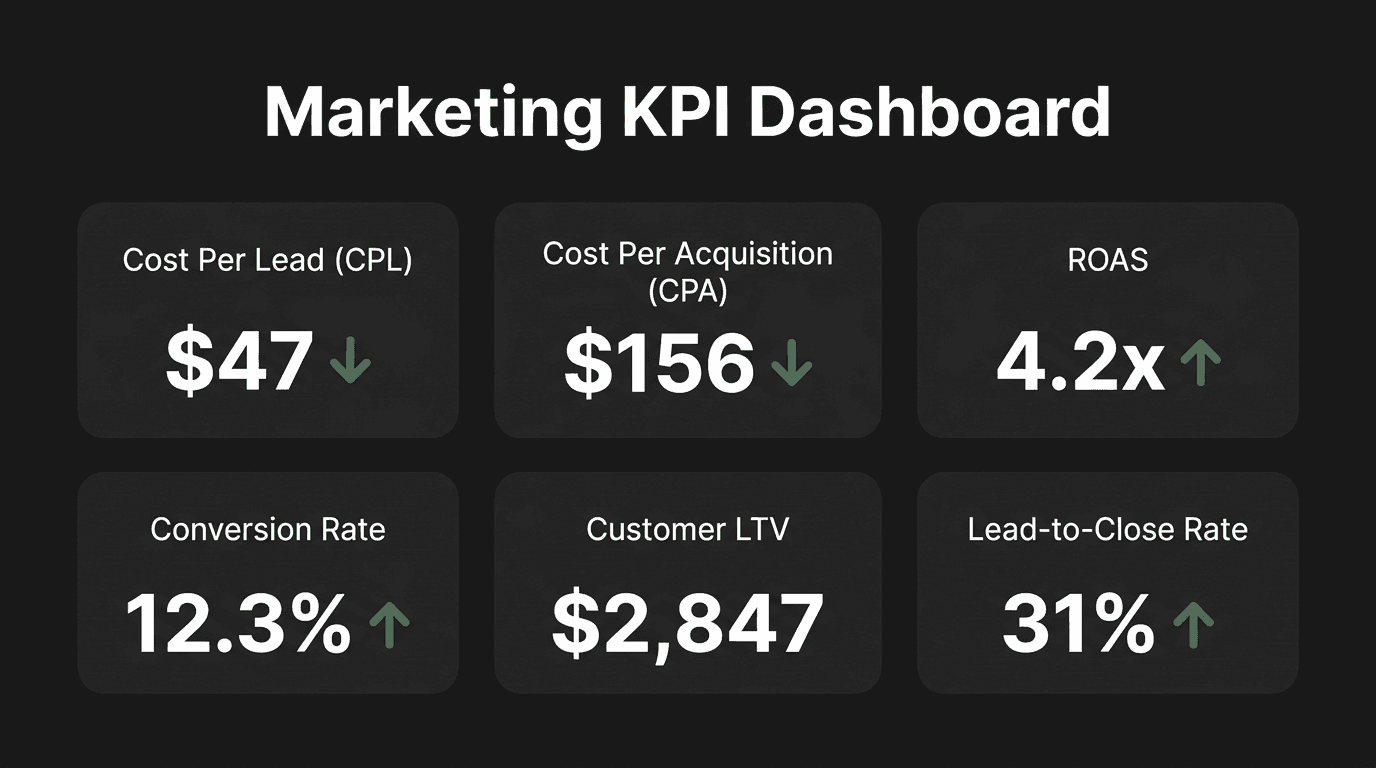
The six metrics below are the ones that actually tell you if your digital marketing strategy is earning its fee or burning your money. Let's break each one down.
2) Metric #1: Cost Per Lead (CPL)
Cost per lead is the most fundamental marketing metric. It answers a simple question: how much does it cost to get someone to contact you? A lead is any inbound inquiry — a phone call, a form submission, a chat message, or a booking request.
Formula
CPL = Total Marketing Spend ÷ Number of Leads
Example: You spend $2,000 on Google Ads and get 40 calls/forms. Your CPL is $50.
CPL Benchmarks by Trade (Google Ads)
CPL varies significantly by trade because average job values and competition levels differ. Higher-ticket services command higher CPLs — and can justify them.
$30-$80
HVAC CPL
$60-$150
Roofing CPL
$25-$65
Plumbing CPL
$35-$90
Electrical CPL
Roofing CPL is the highest because a single job can be worth $8,000–$20,000+, so advertisers bid aggressively. HVAC and electrical sit in a similar mid-range. Plumbing repairs often have lower average job values, which keeps CPL lower — though emergency drain and sewer calls can push toward the higher end. These ranges also shift significantly by market; a competitive metro area will push toward the upper end.
Local Services Ads (LSAs) typically run cheaper: $15–$50 per lead for most trades, with roofing closer to $40–$80 due to high demand during storm seasons. SEO organic leads run even cheaper long-term, typically $10–$30 per lead once rankings are established, since there's no per-click cost.
Track CPL by Channel
Don't just calculate one overall CPL. Break it down by source: Google Ads, SEO, LSAs, referrals, and social media. This shows you which channels deliver the cheapest leads — and which ones you should scale or cut. For roofing contractors, storm season often makes LSAs the top performer; for plumbers, organic search tends to dominate emergency queries.
3) Metric #2: Cost Per Acquisition (CPA)
A lead is not a customer. Just because someone called doesn't mean they booked. CPA measures what it actually costs to win a paying customer, and it's where most contractors get a reality check.
Formula
CPA = CPL ÷ Close Rate
Example: Your CPL is $50 and you close 40% of leads. Your CPA is $50 ÷ 0.40 = $125 per booked job.
CPA Benchmarks by Trade
$150-$400
HVAC CPA
$200-$600
Roofing CPA
$100-$300
Plumbing CPA
$120-$350
Electrical CPA
Roofing has the highest CPA of any residential trade, driven by longer sales cycles, multi-quote competition, and insurance claim complexity. The payoff is proportional: a single booked roof replacement easily generates $10,000+ in revenue. For plumbing companies, lower CPA reflects faster decisions — emergency calls convert quickly because customers are in immediate need.
Why Close Rate Matters More Than CPL
Two contractors can have the exact same cost per lead but dramatically different costs per acquisition based on how well they handle incoming calls and quotes. If your staff misses calls, gives vague pricing, or fails to follow up, your CPA skyrockets even though your marketing is doing its job.
30-50%
typical contractor close rate
55-70%
top-performer close rate
Missed Calls Kill Your ROI
Industry data shows that home service companies miss 20–30% of inbound calls on average. Every missed call is a wasted lead you already paid for. If your CPL is $60 and you miss 25% of calls, you're effectively paying $80 per lead that actually gets answered. This problem hits roofing and electrical contractors especially hard during busy seasons when call volume spikes.
4) Metric #3: Return on Ad Spend (ROAS)
ROAS is the metric that answers the question every contractor actually cares about: for every dollar I put in, how many dollars come back?
Formula
ROAS = Revenue from Marketing ÷ Marketing Spend
Example: You spend $3,000 on marketing and generate $15,000 in revenue from those leads. Your ROAS is 5x (or 500%).
ROAS Targets for Home Service Contractors
3x
minimum viable ROAS
5x
strong ROAS target
8x+
excellent (mature campaigns)
Why 3x Is the Minimum
A 3x ROAS means you earn $3 for every $1 spent. That sounds profitable, but remember: that $3 is revenue, not profit. After labor, materials, overhead, and the marketing cost itself, a 3x ROAS often means you're roughly breaking even. Aim for 5x or higher to ensure real profit. Roofing companies with high job values can sustain lower ROAS thresholds because gross margins are substantial — but the math still has to work.
Calculate ROAS for each marketing channel separately. Google Ads campaigns might deliver 4x while SEO delivers 8x, because organic traffic has no per-click cost. That difference should inform where you allocate more budget. For roofing lead generation, storm-season Google Ads often outperform SEO on a short-term basis because urgency drives search volume, while SEO wins on annual ROAS over a full year.
5) Metric #4: Conversion Rate
Conversion rate tells you what percentage of people who visit your website actually take action. This is where your website design directly impacts your marketing ROI. A better-converting website means more leads from the same traffic, without spending another dollar on ads. This applies equally whether you serve electrical customers or replace roofs — the principles are the same.
Three Conversion Rates to Track
Website Conversion Rate
3-8%
Overall site visitors who call or submit a form. The average contractor site converts around 3%. Top-performing sites built for a specific trade hit 6–8%.
Landing Page Conversion Rate
8-15%
Dedicated landing pages built for Google Ads should convert significantly higher than your general site pages. Emergency service landing pages for plumbers and electricians can hit 15%+.
Phone Answer Rate
90%+
This is the conversion rate most contractors forget. If you only answer 70% of calls, you're losing 30% of paid leads before they even become opportunities.
The Easiest ROI Improvement
Before spending more on ads, check your website conversion rate. If you're at 2% and can get to 4%, you've doubled your leads without increasing ad spend by a single dollar. That's often the highest-ROI change any home service contractor can make — regardless of trade.
6) Metric #5: Customer Lifetime Value (LTV)
Most home service contractors think about marketing in terms of single transactions. But customers don't just buy once. LTV captures the full picture: the initial job, repeat service calls, referrals to neighbors, and big-ticket replacements years down the road. LTV varies widely by trade.
Formula
LTV = Avg Job Value × Avg Repeat Purchases × Avg Customer Lifespan
Example (HVAC): $350 avg repair × 2 repairs/year × 5 years = $3,500 LTV (not counting equipment replacements).
LTV Benchmarks by Trade
$3,500-$12,000
HVAC customer LTV
$8,000-$20,000+
Roofing customer LTV
$1,500-$5,000
Plumbing customer LTV
$1,200-$4,500
Electrical customer LTV
Roofing LTV is the highest because even a single full replacement is a large ticket, and a satisfied customer will refer neighbors and call back for gutters, skylights, or storm damage repairs. HVAC LTV is strong because of recurring maintenance agreements and eventual system replacements. Plumbing and electrical LTV is driven more by recurring service calls and periodic upgrades than by single large jobs.
A Typical Home Service Customer Journey
First Call: Emergency or Urgent Repair
AC stops working, roof is leaking, drain is clogged, or a circuit trips and won't reset. Customer finds you on Google. Job value: $150–$800 depending on trade.
Upsell: Maintenance Plan or Follow-On Work
Technician recommends a maintenance plan, a panel upgrade, or additional work identified on-site. For HVAC, bi-annual tune-ups at $150–$300/year create recurring revenue. For roofers, annual inspections and minor repairs keep the relationship alive.
Big Ticket: System or Full Replacement
3–7 years later, they need a full system or roof replaced. Because you've been their trusted contractor, they call you first — not your competitor. Job values range from $5,000 for an HVAC system to $15,000+ for a full roof replacement.
Referrals: Multiplied LTV
A satisfied customer refers two neighbors. Each of those becomes their own multi-year relationship. Referral customers also have higher close rates and lower CPL since the trust is already established.
How LTV Changes Your Acceptable CPL
If your average LTV is $5,000+, suddenly paying $200 for a customer acquisition isn't scary — it's a 25x return. Most contractors under-invest in marketing because they compare their CPA against a single job value instead of lifetime value. Think long-term and you'll outspend (and outgrow) your competition. This logic is especially powerful for roofing and HVAC companies where LTV is highest.
7) Metric #6: Lead Source Attribution
Attribution answers the question: where did this lead come from? Without it, you're guessing which channels work. With it, you can double down on winners and cut losers.
Common Home Service Lead Sources
Google Ads (Search)
High-intent leads searching for specific services. Usually the most expensive per lead but also the highest quality. Track with UTM parameters and call tracking numbers. Particularly powerful for emergency HVAC and plumbing searches. Manage campaigns at ads.google.com.
SEO / Organic Search
Free traffic from ranking on Google. Lower CPL than ads but takes months to build. Track in Google Analytics under organic traffic. Roofing and HVAC SEO are highly competitive; plumbing and electrical often have quicker ranking opportunities in smaller markets.
Local Services Ads (LSAs)
Pay-per-lead model. Leads come through Google directly. Built-in attribution since every lead is tracked in the LSA dashboard. All four major trades are eligible for Google Guaranteed status.
Referrals & Repeat Customers
Your highest-quality, lowest-cost leads. Ask every caller how they heard about you and log it in your CRM. These leads often have the best close rate and the highest LTV because the relationship starts with existing trust.
Call Tracking Is Non-Negotiable
For home service contractors, 60–80% of leads come in as phone calls. Without call tracking software like CallRail, you have no idea which ad, keyword, or page generated that call. You're flying blind on the majority of your leads. This is true for every trade — from HVAC to roofing to electrical. If you do one thing after reading this article, set up call tracking.
8) How to Set Up Tracking
You don't need a data science degree to track your marketing. Here is the setup that covers 90% of what a home service contractor needs, broken into three layers. This framework works whether you run an HVAC company, a roofing business, a plumbing operation, or an electrical contracting firm.
Layer 1: Website Analytics
- Install Google Analytics 4 (GA4) on every page of your site
- Set up conversion events for form submissions and click-to-call buttons
- Connect Google Search Console to see which keywords bring organic traffic
- Link Google Ads to GA4 so you can see ad performance alongside website behavior
Layer 2: Call Tracking
- Sign up for CallRail (or a similar call tracking platform)
- Create unique tracking numbers for each marketing channel (Google Ads, organic, LSAs, direct mail)
- Enable dynamic number insertion on your website to track calls by source
- Set up call recording to review call quality and train your dispatch or CSR team
Layer 3: CRM Pipeline
- Use your field service CRM (ServiceTitan, Housecall Pro, Jobber, or similar) to track leads from first contact to booked job
- Tag every lead with its source: Google Ads, SEO, referral, LSA, etc.
- Track revenue per lead source so you can calculate ROAS by channel
- Review your pipeline weekly to catch leads that fell through the cracks before they call a competitor
Start Simple, Then Layer On
Don't try to set up everything at once. Start with GA4 and call tracking. Those two alone will show you where 80% of your leads come from. Add CRM pipeline tracking once you have the basics running smoothly. Most contractors see surprising results in the first 30 days of call tracking alone — often discovering they're missing more calls than they realized.
9) Monthly Reporting Template
Tracking metrics is only useful if you actually review them. Set aside 30 minutes at the start of each month to review these numbers. Here is exactly what to look at — regardless of your trade.
Your Monthly Dashboard
Total Leads by Source
How many leads came from each channel this month? Compare to last month and the same month last year. Seasonal patterns vary by trade: roofing peaks post-storm, HVAC peaks in summer and winter, plumbing emergencies are year-round.
Cost Per Lead by Channel
What did you pay per lead from Google Ads, SEO, LSAs, and referrals? Flag any channel where CPL jumped more than 20% from the previous month — it often signals increased competition or a campaign issue.
Close Rate
What percentage of leads turned into booked jobs? If this drops, the problem is usually your sales process, not your marketing. Review call recordings for clues — common issues include slow response time, vague pricing, and failure to follow up on voicemails.
Revenue by Source
How much actual revenue came from each marketing channel? This is where you calculate ROAS and decide where to shift budget. For roofing companies, a single storm-season Google Ads campaign can generate outsized revenue and skew your annual numbers positively.
Website Conversion Rate
What percentage of website visitors contacted you? If traffic is up but conversion rate is down, your site needs work, not more ad spend. A contractor-focused website audit can identify the specific friction points holding your rate down.
Phone Answer Rate
What percentage of inbound calls were answered? Set a target of 90%+. Every missed call is a lead you paid for and wasted — and in home services, customers who don't get an answer within a few minutes will simply call the next contractor on the list.
The 3-Question Monthly Review
After pulling your numbers, answer these three questions:
- What's working? Which channel has the best ROAS? Double down there.
- What's not working? Which channel has rising CPL or falling ROAS? Investigate or cut budget before the next billing cycle.
- Where are we losing leads? Check close rate and phone answer rate. Fix the leaks before adding more water.
Stop Guessing, Start Measuring
The home service contractors who grow fastest aren't the ones with the biggest marketing budgets. They're the ones who know their numbers. When you track CPL, CPA, ROAS, conversion rate, LTV, and lead source attribution, you stop making emotional decisions about your marketing and start making data-driven ones.
Start with the basics: install GA4, set up call tracking, and calculate your CPL by channel. That alone puts you ahead of 72% of contractors across every trade who don't track their marketing ROI at all. From there, add CPA tracking, then build your monthly reporting cadence around the six metrics covered here.
We work with contractors across all home service trades — see how we help HVAC companies, roofing contractors, plumbers, and electricians grow with data-driven marketing. Or start with a free website audit to see exactly where your current marketing is leaking money.