

Every trade has a slow season. HVAC companies watch their phones go quiet every October. Roofers dread the first snow. Plumbers scramble when summer remodels dry up. Electricians coast through spring. The pattern is universal: peak demand hits, then disappears, and most contractors just wait it out.
The contractors who grow year-round are not lucky. They are marketing differently. They are not cutting budgets and watching competitors fill the gap. They are shifting their message to match what customers need right now, building recurring revenue streams, and using the slow months to build the marketing infrastructure that dominates when peak season returns.
This guide covers seasonal patterns for all four major home service trades, six proven strategies to keep revenue flowing year-round, a month-by-month marketing calendar, and a budget reallocation framework. Whether you run an HVAC company, roofing business, plumbing operation, or electrical contracting firm, these strategies apply.
1) Seasonal Patterns by Trade
30-50%
Revenue Drop in Shoulder Seasons
$150-$300
Avg. Maintenance Plan Value/Year
74%
Contractors with No Off-Season Strategy
25-40%
Lower CPCs During Slow Season
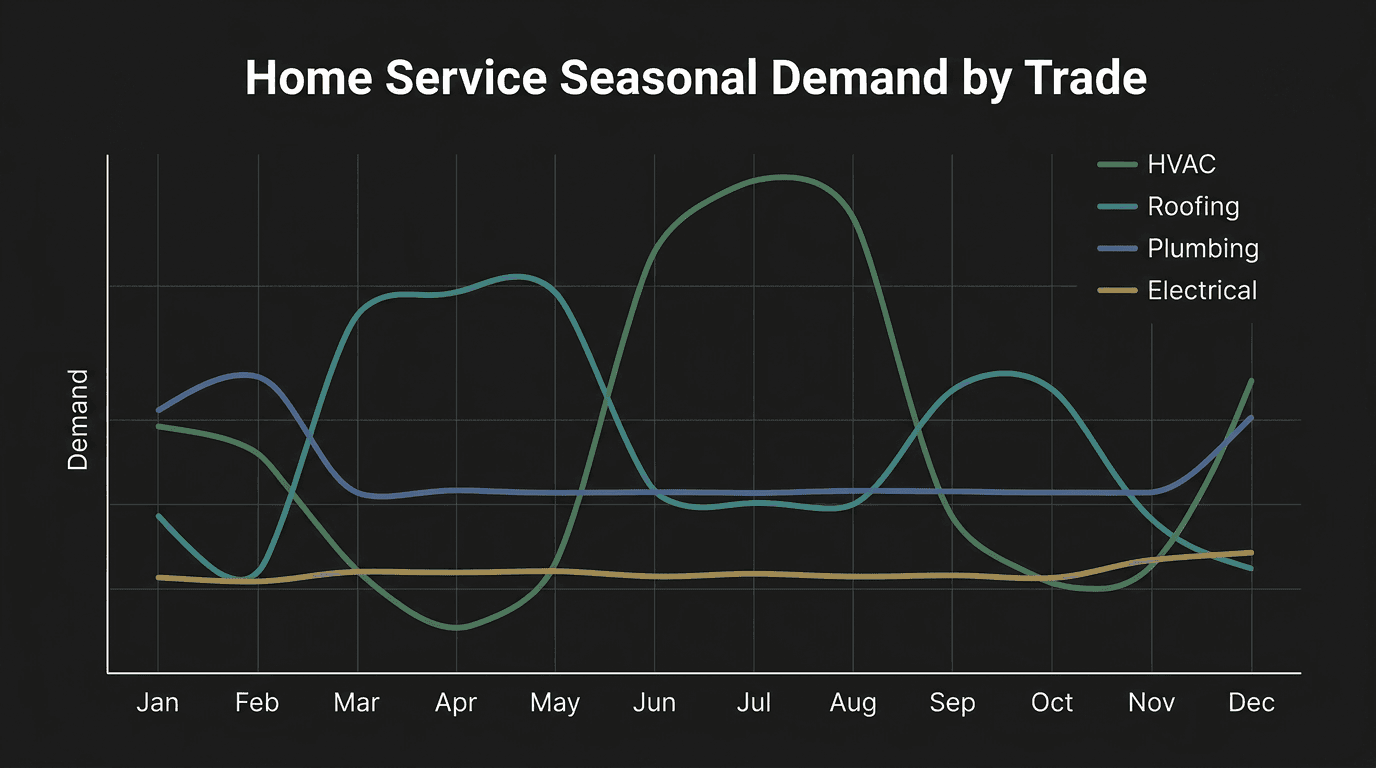
Understanding when your specific trade slows down is the foundation of any seasonal marketing strategy. Each trade has a distinct demand curve. You can validate this in your own market using Google Trends to compare seasonal search volume for your specific services. Here is what that looks like across all four:
HVAC: Shoulder Season Problem
Peak demand hits June through August (cooling) and December through February (heating). The shoulder months — March, April, September, October — can see call volume drop by half. Maintenance tune-ups and indoor air quality services are the bridge.
Roofing: Weather-Dependent Peaks
Spring and fall are prime roofing season in most markets. Summer is secondary. Winter in northern markets is dead for new projects. The wild card: storm season. Post-storm demand spikes can be larger than any planned peak. Storm-response marketing systems are essential.
Plumbing: The Freeze-Thaw Cycle
Winter freeze events drive emergency calls (burst pipes, frozen pipes) and are the single highest-revenue days a plumber can have. Summer and fall are slower for emergency work but prime for remodel and upgrade projects. Spring brings sewer line and water heater demand.
Electrical: Steady but Cyclical
Electrical is the most consistent trade year-round, but demand peaks are real. Winter drives holiday lighting installs, heating system electrical upgrades, and panel demand. Summer brings pool and outdoor circuit work. EV charger installation is a year-round growth category that smooths seasonal dips for forward-thinking electricians.
Industry averages across residential markets. The gap between contractors who market year-round and those who go dark during shoulder seasons compounds over time.
2) The Slow Season Trap
Most home service contractors respond to slow seasons the same way: cut the marketing budget, pull back on Google Ads, stop posting content, and wait for demand to return. It feels responsible. It is actually the most damaging thing you can do to your pipeline.
Why "Waiting It Out" Kills Growth
- Google Ads campaigns lose optimization data. When you pause campaigns, you lose the machine learning and quality scores you spent months building. Restarting means re-entering the learning phase at higher costs during peak season when you can least afford it.
- SEO momentum stalls. Google rewards consistency. Stopping content production and link building for three months means your competitors gain ground while you stand still. That ground takes months to recover.
- Cash flow becomes a rollercoaster. Peak months cover the slow months, but barely. One bad storm season for a roofer, a mild winter for an HVAC company, or a slow remodel market for a plumber can put your business in a dangerous cash position.
- Your competitors fill the gap. The contractors who keep marketing during slow season capture the customers you are ignoring. Those customers remember who showed up when they needed help, and who was nowhere to be found.
The Revenue Rollercoaster Trap
If you only market during peak season, you are stuck in a cycle: feast in peak, famine in shoulder, scramble to recover, repeat. The only way to break the cycle is to build marketing systems that generate revenue year-round, not just when the weather cooperates. See how year-round contractor marketing compounds over time.
3) Strategy 1: Maintenance Plan Marketing
Maintenance agreements are the single best tool for smoothing out seasonal revenue across every trade. A customer on a plan pays you a predictable annual fee for scheduled visits, priority scheduling, and repair discounts. More importantly, they are a locked-in customer who will not call your competitor when something breaks.
The math works for every trade. 200 HVAC maintenance customers at $200/year is $40,000 in predictable revenue plus $70,000-$100,000 in found repair work during tune-ups. 100 plumbing annual inspection plan customers at $200/year is $20,000 with consistent upsell opportunity on aging water heaters, fixtures, and drain systems.
Maintenance Plan Benchmarks by Trade
- HVAC: $149-$249/year per system. Two tune-ups (spring AC, fall heating), priority scheduling, 15% repair discount. Upsell IAQ services during visits.
- Roofing: $99-$199/year. Annual inspection, minor repairs included (sealant, flashing), storm damage assessment after major weather events. Positions you first-in-line for full replacements.
- Plumbing: $149-$249/year. Annual whole-home plumbing inspection, water heater flush, drain health check. High upsell rate on aging water heaters and fixture upgrades found during visits.
- Electrical: $99-$149/year. Annual safety inspection, panel check, GFCI and smoke detector test. Natural upsell for panel upgrades, EV charger pre-wiring, and generator installs.
How to Market Maintenance Plans During Slow Season
Add a dedicated landing page for your maintenance plan. Run Google Ads targeting "[trade] maintenance plan near me" and "annual [trade] inspection." These keywords are far cheaper off-peak. Train every tech to pitch the plan on every job. The lifetime value of a maintenance customer far exceeds any first-year discount you offer to acquire them.
4) Strategy 2: Off-Season Google Ads
Here is something most home service contractors do not realize: cost-per-click for trade keywords drops significantly during shoulder seasons. While everyone else is pulling back their budgets, the contractors who keep advertising on Google get more leads for less money. The opportunity is largest for HVAC and roofing, but every trade sees meaningful CPC reductions off-peak.
$18-$35
Peak Season Avg. CPC
$8-$18
Off-Peak Avg. CPC
40-60%
Lower Competition Off-Peak
2-3x
Better ROAS Off-Peak
The key is shifting what you advertise. During your trade's shoulder season, emergency and replacement volume drops naturally — but inspection, maintenance, and upgrade searches do not. Shift your keyword targeting to match what customers are actually searching for. See the full breakdown of roofing advertising strategies and plumbing lead generation for trade-specific keyword guidance.
Off-Season Keyword Targets by Trade
- HVAC (spring/fall): "AC tune-up near me," "furnace maintenance," "HVAC preventive maintenance," "duct cleaning near me," "indoor air quality testing"
- Roofing (winter/mid-summer): "roof inspection near me," "roof maintenance," "attic insulation estimate," "gutter cleaning and repair," "roof financing options"
- Plumbing (summer/fall): "water heater replacement," "drain cleaning service," "bathroom remodel plumber," "whole home repiping estimate," "sewer line inspection"
- Electrical (spring/summer): "EV charger installation near me," "panel upgrade estimate," "whole home generator install," "outdoor lighting electrician," "smart home wiring"
Don't Pause — Reallocate
Instead of pausing campaigns entirely, reduce your emergency and replacement campaign budgets by 30-40% and redirect that spend to maintenance, inspection, and upgrade campaigns. You keep your campaign data and quality scores intact while targeting services that match seasonal demand.
5) Strategy 3: Email & SMS Campaigns
Your past customer list is the highest-ROI marketing asset you own during slow season. These are people who already trust you, already have your contact info saved, and whose homes need your services again. A well-timed email or text can turn a quiet week into a fully booked one at near-zero cost.
The key is relevance and timing. Do not send generic "we miss you" blasts. Send seasonal reminders tied to real, trade-specific needs. Here are high-converting campaign types for each trade:
HVAC: Spring "Get Ready for Summer"
Send in March/April. Remind customers their AC has not been serviced since last year. Include a limited-time tune-up offer. Mention that scheduling now avoids the summer rush and guarantees priority service when heat waves hit.
Roofing: Post-Storm Outreach
Send within 24-48 hours of a significant hail or wind event. "We noticed [city] got hit last night. Your roof may have damage that is not visible from the ground. We are offering free storm damage inspections this week." This single campaign type can fill a roofing calendar for weeks.
Plumbing: Winter Freeze Prep
Send in October/November before the first freeze. "Frozen pipes are the most expensive plumbing emergency homeowners face. Here is how to prepare your home — and how to reach us fast if something goes wrong." Positions you as the expert before emergencies happen.
Electrical: EV Charger & Holiday Lighting
Two separate sends. In October: "Planning holiday lighting this year? We install outdoor circuits and dedicated outlet runs so you can skip the extension cord fire hazards." Year-round: "Got an EV or planning to? Home charger installations are booking 3-4 weeks out. Reserve your spot now."
Post-Service Follow-Up (All Trades)
Send 11 months after their last service. "It's been almost a year since we serviced your [system/roof/plumbing/panel]. Time for your annual checkup?" This is the highest-converting email any trade can send because it is personally relevant to that customer.
Equipment Age Alert (All Trades)
Track install dates and trigger messages when equipment hits 8, 10, 12, and 15 years. "Your water heater is 11 years old. Average lifespan is 10-15 years. Here is what replacement costs look like — and why planning ahead saves you from an emergency." Plants the seed for replacement conversations before equipment fails.
SMS vs Email
SMS has a 98% open rate versus 20-25% for email. Use SMS for time-sensitive offers, post-storm outreach, and appointment reminders. Use email for longer seasonal guides, equipment age alerts, and maintenance plan details. The best approach uses both: send an email with full context, followed by a text reminder two days later.
6) Strategy 4: Ancillary & Add-On Services
Every trade has adjacent services that are less seasonal than core work. These fill schedule gaps, increase average ticket size, and introduce your business to customers who might not have called for your primary service. The Harvard Joint Center for Housing Studies consistently reports that home improvement spending grows even in slower economic periods as homeowners invest in comfort and efficiency upgrades. Promoting ancillary services aggressively during slow months is one of the fastest ways to stabilize revenue.
High-Value Add-Ons by Trade
- HVAC — Indoor Air Quality (IAQ): Whole-home air purifiers ($1,000-$3,000 installed), UV germicidal lights ($500-$1,200), whole-home dehumidifiers ($1,500-$2,500), and duct cleaning ($400-$800) are all year-round demand services that peak in spring and fall. Post-pandemic awareness of IAQ has permanently elevated consumer interest.
- Roofing — Insulation & Gutters: Attic insulation installation and air sealing are legitimate roofing adjacencies with strong winter and shoulder-season demand. Gutter cleaning, repair, and replacement installs bridge the gap between roofing prime seasons. Average ticket is $300-$800 for gutters and $2,000-$6,000 for insulation work.
- Plumbing — Water Quality & Remodels: Whole-home water filtration systems ($1,500-$4,000 installed), water softener installs ($1,200-$3,000), and bathroom or kitchen remodel plumbing rough-in are premium off-peak revenue. These projects are planned purchases, not emergencies — customers research them during slower months.
- Electrical — EV Chargers & Generators: EV charger installation ($800-$2,500) is effectively year-round demand that grows annually as EV adoption accelerates. Whole-home generator installation ($5,000-$15,000) spikes before and after major storms but has steady baseline demand. Both are high-ticket, high-margin, and not weather-dependent.
Visibility Requires Dedicated Marketing
Adding ancillary services without marketing them is like opening a store without a sign. Create specific landing pages for each add-on, run targeted search ads, and train your techs to recommend these services on every job. The service has to be visible and actively promoted to generate revenue — it will not sell itself.
7) Strategy 5: SEO Content During Downtime
Slow season is the best time to invest in SEO content. Your team has more bandwidth, there is less competitive noise, and the content you build now will start ranking just in time for peak season. SEO is a compounding asset: every page you publish this quarter generates leads for years.
Most home service contractor websites have a homepage, an about page, and a generic services page. That is not enough to compete in organic search. Google rewards depth and specificity. Use your downtime to build the content architecture that drives organic leads at zero marginal cost.
Content to Build During Slow Season
- Individual service pages. One page per service. Each page targets its own keyword cluster and converts visitors looking for that specific service. "AC Repair," "Furnace Installation," "Roof Inspection," "Water Heater Replacement," "EV Charger Installation" — each deserves its own dedicated page.
- Location pages. If you serve multiple cities or neighborhoods, create a page for each. "[Service] in [City]" pages rank for local searches and signal your service area to Google. Aim for 10-20 location pages covering your core markets.
- Blog posts answering customer questions. "How much does roof replacement cost?" "When should I replace my water heater?" "How long does an EV charger installation take?" These informational queries drive top-of-funnel traffic that converts over time. See examples of high-converting roofing content and plumbing lead generation content.
- Comparison and buying guides. "Central AC vs. Mini Split," "Asphalt vs. Metal Roofing," "Tankless vs. Tank Water Heater," "Level 1 vs. Level 2 EV Charger." These pages capture high-intent research traffic from homeowners planning a purchase.
The 90-Day SEO Sprint
Set a goal to publish 2-3 new pages per week during your slow season. In a 90-day sprint, that is 25-40 new pages targeting specific keywords. By the time peak season arrives, those pages are indexed, gaining authority, and starting to rank. This is the highest-ROI investment you can make during the off-season.
8) Strategy 6: Referral & Review Campaigns
Slow season gives you something peak season does not: time. Use it to build the systems that generate free leads year-round — referral programs and Google review generation. A referred customer converts at 3-5x the rate of a cold lead. Businesses with 50+ Google reviews see 35% more clicks from local search results. Neither channel requires ad spend. Both require a system.
Build These Systems During Slow Season
- Automate review requests. Set up automated SMS or email review requests that trigger after every completed job. Use tools like Podium, Birdeye, or a simple CRM automation. The goal is 100% follow-up on every job — not just the good ones.
- Create a referral program. Offer $50-$100 credit for every referred customer who books a job. Print referral cards for techs to hand out. Add a referral page to your website. Make it dead simple to refer. Works for every trade.
- Partner with realtors (HVAC, roofing, plumbing). Real estate transactions require HVAC inspections, roof certifications, and plumbing assessments. One relationship with an active real estate agent can generate 2-5 jobs per month year-round.
- Connect with property managers (all trades). Property management companies need reliable contractors for every trade year-round. One relationship with a property manager who oversees 50-100 units can fill your slow-season calendar on its own at zero ad spend.
- Respond to every review. Use slow season to respond to all existing Google reviews you have not answered yet. Thank positive reviewers by name and address negative reviews professionally. This signals to Google that you are an active, engaged business and improves your local ranking.
The Property Manager Play
Reach out to 10 property management companies in your area with a simple offer: discounted maintenance rates for their portfolio in exchange for being their preferred contractor. For any trade, one property management relationship generating 5-10 jobs per month is worth $30,000-$80,000+ in annual revenue with zero ad spend.
9) Monthly Marketing Calendar
Stop guessing what to promote each month. Here is a month-by-month marketing calendar that covers all four major home service trades. Not every month applies to every trade — use the ones relevant to your business. Adjust timing based on your climate zone; southern markets shift cooling earlier, northern markets shift heating prep earlier.
January
HVAC: Push emergency heating repair ads. Run "New Year, New System" replacement promotions. Send maintenance plan renewal emails. Electrical: Post-holiday electrical safety content, panel upgrade campaigns. Plumbing: Freeze emergency ads, water heater failure content. Roofing: Ice dam content, spring booking early-bird offers.
February
HVAC: Launch early-bird AC tune-up booking campaigns. Send "schedule your spring maintenance" emails. Plumbing: Water heater replacement offers, whole-home repiping education. Electrical: Generator installation campaigns, EV charger awareness content. Roofing: Spring booking push, financing promotions for replacements.
March
HVAC: Shift ads to AC maintenance, launch IAQ (allergy season). Email past customers about spring tune-ups. Roofing: Spring prime season begins — ramp all channels. Storm-response system on standby. Plumbing: Sewer line inspection promotions, spring remodel outreach. Electrical: EV charger, outdoor electrical, and panel upgrade campaigns.
April
HVAC: Heavy AC tune-up marketing. Maintenance plan push. Roofing: Full peak season — emergency ads, inspection campaigns, post-storm response. Plumbing: Water heater flush promotions, bathroom remodel season begins. Electrical: Outdoor living electrical, generator installs, smart home wiring.
May
HVAC: Ramp emergency AC repair ads. Transition to repair/replacement messaging. Promote financing. Roofing: Peak continues — maximize ad spend. Review collection push. Plumbing: Remodel season in full swing. High-ticket project campaigns. Electrical: Pool, spa, and outdoor circuit work; EV charger demand rising.
June
HVAC: Peak cooling season — maximize ad spend on AC repair and replacement. Roofing: Strong demand continues; begin building fall campaign creative. Plumbing: Remodel and outdoor plumbing work peak. Irrigation season. Electrical: Peak outdoor electrical season. Panel upgrade demand from new homeowners.
July
HVAC: Continue peak AC marketing. Launch referral campaigns from summer jobs. Roofing: Solid demand; collect peak-season reviews aggressively. Plumbing: Maintain remodel campaigns. Water quality campaigns (summer water taste concerns). Electrical: Outdoor and pool electrical, EV charger, smart home installs.
August
HVAC: Begin transitioning to "end of summer" messaging. Tease fall heating tune-up campaigns. Roofing: Begin fall booking push. Storm season messaging. Plumbing: Pre-winter plumbing inspection promotions. Drain cleaning season. Electrical: Back-to-school home safety electrical content. Panel upgrade push before fall busy season.
September
HVAC: Shift to heating maintenance ads. Launch "furnace ready for winter" email campaign. Roofing: Fall prime season — ramp all channels. Post-summer storm response. Plumbing: Pre-winter freeze prep content. Water heater replacement push. Electrical: Generator installs before winter. Heating system electrical.
October
HVAC: Heavy heating tune-up marketing. Push maintenance plan sign-ups. Roofing: Peak fall season — full ad budgets. Last push before winter. Plumbing: Pre-freeze inspection campaigns. Emergency pipe insulation content. Electrical: Holiday lighting circuit installs, outdoor lighting, generator pre-winter push.
November
HVAC: Ramp emergency heating ads. Equipment age alerts to customers with older furnaces. Roofing: Final push before winter. Winter storm damage response prep. Plumbing: Freeze emergency ads. Year-end water heater replacement promotions. Electrical: Holiday lighting installs, panel upgrade year-end offers.
December
HVAC: Peak heating season — maximize emergency repair spend. Roofing: Maintain storm damage ads. Plan spring strategy. Plumbing: Freeze emergency ads, year-end promotions on planned replacements. Electrical: Holiday lighting circuit repairs, plan Q1 EV charger and generator campaigns. Thank loyal customers.
Adapt to Your Market
This calendar assumes a four-season climate in the continental United States. Florida and Arizona HVAC companies run cooling season nearly year-round; heating is minimal. Gulf Coast roofing companies have a longer storm season. Pacific Northwest electrical demand for EV chargers tracks closely with regional EV adoption rates. The principle stays the same: market what customers need right now, and use shoulder months for maintenance, add-ons, and business development.
10) Budget Reallocation Guide
The biggest mistake home service contractors make during slow season is not overspending — it is cutting the budget entirely. The smart move is reallocation, not reduction. Spend roughly the same total marketing budget year-round but shift where that money goes based on seasonal demand patterns for your trade.
Q1 (January – March): Emergency Peak + Spring Prep
- 50% to Google Ads: Emergency heating (HVAC) and freeze (plumbing) campaigns running full throttle in Jan-Feb. Roofing spring booking ads launch in March. Electrical panel and generator campaigns year-round.
- 20% to SEO & Content: This is your content production quarter. Publish service pages, location pages, and blog posts that will rank by peak season.
- 15% to Email/SMS: Spring tune-up reminders (HVAC), spring booking offers (roofing), pre-season inspection campaigns (plumbing/electrical).
- 15% to Reviews & Referrals: Invest in review generation tools, referral program setup, and partner outreach (realtors, property managers).
Q2 (April – June): Peak Season Ramp-Up
- 60% to Google Ads: HVAC AC repair and replacement ramp by June. Roofing at full peak. Plumbing remodel and sewer campaigns. Electrical outdoor and EV charger.
- 15% to SEO & Content: Maintain content cadence but shift topics to match peak season services. Optimize existing pages for summer keywords.
- 15% to Email/SMS: Last-chance maintenance offers, financing promotions for new systems and projects, referral incentives for peak-season customers.
- 10% to Add-On Services: IAQ and duct cleaning for HVAC; water quality and filtration for plumbing; generator and panel for electrical; gutters for roofing.
Q3 (July – September): Peak + Fall Prep
- 55% to Google Ads: HVAC maxes in July-August, shifts to heating in September. Roofing transitions to fall prime. Plumbing pre-winter prep. Electrical generator and heating electrical.
- 15% to SEO & Content: Publish fall and winter content now so it indexes before your next peak season.
- 15% to Reviews & Referrals: Peak volume means peak review opportunity. Follow up on every summer job. Activate referral program while customers are most satisfied.
- 15% to Email/SMS: Fall tune-up campaigns, system replacement follow-ups from summer quotes, pre-winter inspection offers.
Q4 (October – December): Fall Peak + Year-End
- 55% to Google Ads: HVAC heating tune-ups in October, emergency repair in November-December. Roofing fall prime then winter storm damage. Plumbing freeze prep and water heater replacement. Electrical holiday and generator.
- 20% to SEO & Content: Plan next year's content calendar. Build out any service page gaps. Update existing content with current year data and pricing.
- 15% to Email/SMS: Maintenance plan renewals, holiday booking reminders, year-end promotions, thank-you campaigns for loyal customers.
- 10% to Partnerships: Renew property management relationships, realtor partnerships, and builder contacts for the new year across all trades.
Never Cut to Zero
Even in your slowest month, maintain a minimum baseline spend on Google Ads and SEO. Pausing campaigns costs you optimization data, quality scores, and ranking momentum that takes months to rebuild. It is far cheaper to maintain a $500-$1,000/month minimum than to restart from scratch during the first week of peak season when you need leads immediately.
Stop Waiting for Peak Season
The home service contractors who grow consistently across all four trades are not the ones with the biggest peak-season budgets. They are the ones who market year-round. Maintenance plans create predictable recurring revenue. Shoulder-season ads capture leads at lower costs. Email and SMS campaigns re-engage past customers who already trust you. Ancillary services fill schedule gaps. SEO content compounds over years. Referrals and reviews generate free leads indefinitely.
None of these strategies require a massive budget increase. They require a shift in thinking: from "marketing is a peak-season expense" to "marketing is a year-round investment." The contractors who make this shift stop riding the revenue rollercoaster and start building predictable, sustainable growth — regardless of whether the weather cooperates. Whether you run an HVAC company, roofing business, plumbing operation, or electrical firm, the framework is the same.
If you are tired of slow seasons and ready to build a marketing system that works every month of the year, start with a free audit. We will show you exactly where your marketing gaps are and build a plan to fill them.