
An HVAC company lives and dies by its schedule. Empty slots in the calendar mean idle technicians, stalled cash flow, and pressure to take low-margin work just to keep the trucks rolling. The solution is a lead generation system that works year-round — not a single tactic, but a multi-channel engine that consistently fills your dispatch board with the right jobs at the right cost.
This guide covers every major HVAC lead generation channel: Google Ads, Local Services Ads, local SEO, website conversion, referrals, and seasonal campaigns. For each channel you'll get real cost-per-lead benchmarks, close rate data, and a clear picture of where each one fits in your overall strategy. By the end, you'll know exactly which channels to prioritize and how to measure whether they're working.
For the full marketing picture beyond lead generation, see our HVAC marketing pillar guide. If you're evaluating whether to handle this in-house or hire out, our HVAC marketing agency guide walks through that decision.
$30-$80
Google Ads CPL (repair)
$20-$50
LSA CPL
25-35%
exclusive lead close rate
3-5x
more leads: multi-channel vs single
1) The HVAC Lead Generation Landscape
Before choosing channels, it helps to understand the three types of HVAC leads — because each has a very different profile in terms of cost, urgency, and average job value.
Emergency Repair Leads
High urgency, same-day booking. AC down in August, furnace out in January. Highest close rate (often 70%+) because the customer can't wait. Shorter job duration but consistent demand. Google Ads and LSAs dominate here.
Maintenance & Tune-Up Leads
Lower urgency, often scheduled weeks out. Maintenance plan members have the highest lifetime value. These leads respond well to SEO, email marketing, and seasonal campaigns. Close rate: 40-60%.
System Replacement Leads
Highest average job value ($5,000-$15,000). Often researched over days or weeks. The customer compares multiple quotes. Google Ads targeting replacement keywords, strong reviews, and a conversion-optimized website matter most here.
There is also an important distinction between owned leads and rented leads. Understanding this split is the foundation of a sustainable lead generation strategy.
Owned Leads (SEO, Referrals, Direct)
Pros
Cons
Rented Leads (Google Ads, LSAs, Aggregators)
Pros
Cons
The Right Mix for Most HVAC Companies
Start with rented leads (Google Ads + LSAs) for immediate cash flow, then build owned assets (SEO, reviews, referrals) in parallel. After 6-12 months, your owned channels reduce your dependence on paid ads and lower your overall cost per lead. Companies relying solely on paid ads are one algorithm change or budget cut away from an empty schedule.
Lead Source Comparison at a Glance
| Google Ads | LSAs | Organic SEO | Aggregators | |
|---|---|---|---|---|
| Cost Per Lead | $30-$120 | $20-$50 | $0 (post-invest) | $15-$40 |
| Speed to First Lead | 1-3 days | 1-5 days | 3-12 months | 1-7 days |
| Lead Exclusivity | Exclusive | Exclusive | Exclusive | Shared (3-5 cos) |
| Close Rate | 25-40% | 25-35% | 30-45% | 5-10% |
| Scales With Budget | ||||
| Works During Slow Season |
2) Google Ads for HVAC Leads
Google Search Ads remain the fastest, most controllable source of high-intent HVAC leads. When a homeowner types "AC repair near me" or "furnace replacement [city]," they are ready to book. That intent makes Google Ads uniquely valuable — you're not interrupting someone, you're appearing exactly when they're looking for you.
$30-$80
repair lead CPL
$50-$120
replacement lead CPL
$8-$20
avg cost per click (HVAC)
10-15%
landing page conversion rate
Campaign Structure That Works
The biggest mistake HVAC companies make with Google Ads is running a single campaign for all services. Separate campaigns give you granular budget control and prevent high-cost replacement keywords from cannibalizing budget meant for repair campaigns. See our complete Google Ads for HVAC setup guide for the full campaign structure.
Emergency Repair Campaign
Target high-urgency keywords: 'AC repair near me,' 'HVAC repair emergency,' 'furnace not working.' Highest CPCs but also highest close rates. Budget 40-50% of your total Google Ads spend here during peak season.
System Replacement Campaign
Target replacement and installation keywords: 'new AC unit installation,' 'HVAC system replacement cost.' These leads take longer to close but have 10x the job value. Requires a dedicated landing page with financing info and trust signals.
Maintenance & Tune-Up Campaign
Target lower-intent but high-LTV keywords: 'AC tune-up,' 'HVAC maintenance plan,' 'furnace tune-up near me.' Lower CPCs and a great way to build your maintenance plan subscriber base.
Brand & Competitor Campaign
Bid on your brand name to capture direct searches and protect against competitor poaching. Consider competitor keywords in markets where you have pricing or review advantages.
Budget Planning for HVAC Google Ads
A minimum viable Google Ads budget for most HVAC companies is $2,000-$3,000/month in a competitive metro market. That generates roughly 25-50 leads depending on your market's CPC. See our HVAC Google Ads budget guide for a market-by-market breakdown and how to scale as you prove ROI.
What Kills HVAC Google Ads Performance
- • No call tracking: 60-80% of HVAC leads come in as phone calls. Without call tracking, you can't see which keywords generate actual calls.
- • Sending traffic to the homepage: Dedicated landing pages for each service convert 2-3x higher than homepages.
- • Broad match keywords without negatives: "HVAC" on broad match will pull irrelevant searches like HVAC school, HVAC parts, HVAC jobs. Add robust negative keyword lists.
- • Not tracking by service type: Replacement leads have a different value than repair leads. Optimize bids separately or you'll over- or under-invest in each.
3) Local SEO & Map Pack
Local SEO is the highest-ROI long-term investment in HVAC lead generation. Once you rank in the Google Map Pack for "AC repair [city]" or "HVAC company near me," every lead that comes in costs you nothing beyond your initial investment. The challenge is that it takes time — typically 3-6 months to see meaningful results — which is why SEO should run in parallel with paid channels, not instead of them.
3-6 mo
time to first Map Pack rankings
$0
cost per lead once ranked
30-45%
SEO lead close rate
The Three Pillars of HVAC Local SEO
Google Business Profile
Your GBP is the single most important local SEO asset. Complete every field, add photos weekly, post updates, and respond to every review within 24 hours. See our full GBP optimization guide for HVAC.
Service Area Pages
Create dedicated pages for each city or ZIP code you serve: "AC Repair in [City]" with local phone number, testimonials from nearby customers, and embedded map. Each page targets a geographic cluster of keywords and builds topical authority.
Google Reviews
Review velocity and recency are among the strongest Map Pack ranking signals. Aim for 2-4 new reviews per week with a consistent follow-up system. Our HVAC Google reviews guide covers the full automation stack.
The Fastest Local SEO Win
If you only have time for one thing, optimize your Google Business Profile completely and set up an automated review request via text after every job. These two actions alone can move you from page 2 of the Map Pack to the top 3 within 60-90 days in most markets.
For a complete SEO strategy including on-page optimization, service pages, and link building, our HVAC SEO service page outlines what a full local SEO engagement looks like.
4) Local Services Ads (LSAs)
Local Services Ads (also called Google Guaranteed ads) are Google's pay-per-lead product for home service businesses. They appear above regular Google Ads, include a green "Google Guaranteed" badge, and charge you only when a customer actually contacts you — not per click. For HVAC companies that qualify, LSAs are often the lowest cost-per-lead channel available.
$20-$50
avg LSA CPL
#1
position on Google (above all ads)
Pay/Lead
billing model (not per click)
2-4 wks
typical approval time
LSAs vs Google Search Ads: Which Should You Run?
LSAs and Google Search Ads are complementary, not competing. Many HVAC companies run both simultaneously to dominate the top of search results. The short answer: run LSAs for cost efficiency on emergency and repair calls, and use Google Ads for more targeted control over replacement and maintenance campaigns. See our LSAs vs Google Search Ads comparison for a detailed breakdown.
To Get Google Guaranteed, You Need:
- A valid contractor license in your state/county
- Proof of general liability insurance (minimum $1M)
- Pass Google's background check for all technicians
- At least 5 Google reviews with an average of 3.0+ stars
Our Google Guaranteed qualification guide walks through the full process and common rejection reasons.
Disputing Invalid LSA Leads
LSAs charge you for every lead — including wrong-number calls, out-of-area calls, and calls from competitors. Google allows you to dispute invalid leads within 30 days. Review every lead in your LSA dashboard weekly and dispute ones that don't qualify. Most HVAC companies recover 10-20% of their LSA spend through disputes.
5) Website Conversion Optimization
Every dollar you spend on Google Ads, LSAs, or SEO eventually sends traffic to your website. If that website converts at 2% instead of 5%, you need 2.5x more traffic — and 2.5x the ad spend — to get the same number of leads. Before adding budget to any lead channel, audit your website's conversion rate. It's often the highest-ROI change you can make.
2-3%
avg HVAC site conversion rate
6-8%
top-performing HVAC sites
2x
lead increase from 3% to 6% CVR
$0
extra ad spend needed
The 5 Elements of a High-Converting HVAC Website
Phone Number in the Header (Always Visible)
Your phone number should appear in the top-right corner of every page, clickable on mobile. Don't bury it. HVAC customers often call within seconds of landing on your site — if they have to hunt for your number, they bounce.
Above-the-Fold CTA on Every Service Page
Each service page should have a clear primary CTA above the fold: 'Call Now,' 'Get a Free Estimate,' or 'Book Online.' Remove any friction between intent and action. Avoid sliders, auto-play videos, or anything that delays the CTA load.
Trust Signals (License, Reviews, Guarantee)
Display your license number, insurance badges, review stars from Google/BBB, and any service guarantees near your CTAs. Homeowners are letting strangers into their home — trust is the conversion barrier, not price.
Mobile Speed Under 3 Seconds
Over 70% of HVAC search traffic is mobile. A site that loads in 5+ seconds on a phone converts at roughly half the rate of a 2-second site. Use Google PageSpeed Insights to find your biggest performance bottlenecks.
Dedicated Landing Pages for Paid Traffic
Never send Google Ads clicks to your homepage. Build dedicated landing pages for each campaign with a single, focused CTA, relevant service info, and no navigation menu to distract visitors. These pages should convert at 8-15%.
For a complete website audit framework, our HVAC website design guide covers every element that impacts conversion — from page structure to color psychology. See also our website development service if you need a conversion-focused rebuild.
6) Referral & Review Systems
Referral leads close at the highest rate of any source — often 50-70% — because they come with built-in trust. A neighbor, friend, or family member vouching for your company does more persuasion work than any ad campaign. Yet most HVAC companies have no formal system to generate referrals. It just "happens." That's leaving significant revenue on the table.
Building a Referral System
- Ask for referrals at job completion: "Do you know anyone else who could use our help with their HVAC?"
- Create a referral incentive: $50-$100 off their next service call for every referral that books a job
- Send a 30-day follow-up email or text after installation jobs with a referral ask
- Use your CRM to flag customers who have referred previously and give them VIP treatment
- Track referral source in your CRM so you can measure your referral rate
Review Generation at Scale
- Send a review request text within 2 hours of job completion while the experience is fresh
- Include a direct link to your Google review page — no hunting required
- Set a company goal: 2-4 new reviews per week. Track it weekly in your team meeting
- Respond to every review — positive and negative — within 24 hours. Responses signal active ownership to Google
- Automate the follow-up sequence with your CRM or a tool like NiceJob or Podium
Reviews Are Your Best Lead Generation Asset
A Google Business Profile with 200+ reviews and a 4.8 average rating will consistently outrank competitors with fewer reviews, even if those competitors have better websites or more backlinks. Reviews are the most accessible ranking lever for most HVAC companies. Our HVAC Google reviews guide covers the full system including templates and automation.
7) Seasonal Lead Generation
HVAC lead volume is inherently seasonal. Summer and winter peak seasons flood the schedule; spring and fall create gaps that drive HVAC owners to cut budgets at exactly the wrong time. A seasonal lead generation strategy uses the slow season to build momentum for the next peak. Companies that market aggressively in the off-season come out of it with more maintenance plan subscribers, better SEO rankings, and lower CPLs than competitors who paused everything.
Peak Season (Summer AC / Winter Heating)
- • Max budget on emergency repair keywords — CPL is higher but close rate is 70%+
- • Ensure 24/7 call coverage; every missed call is $50-$120 in wasted ad spend
- • Activate "emergency" ad copy: "Same-day AC repair," "We answer nights & weekends"
- • Promote maintenance plan sign-ups at point of service while the pain is fresh
- • Upsell system replacement to units 10+ years old during repair calls
Slow Season (Spring AC / Fall Heating)
- • Shift budget to tune-up keywords: "spring AC tune-up," "fall furnace check" — CPCs drop 20-40%
- • Email and text campaigns to your existing customer base promoting seasonal maintenance
- • Publish SEO content targeting next season's emergency keywords so you rank before the rush hits
- • Run LSA campaigns for off-season services with reduced competition
- • Offer maintenance plan promotions: "Sign up in April, save 20%"
The complete playbook for generating leads during slow periods is covered in our HVAC slow season marketing guide, including specific ad copy templates and email sequences that convert off-season traffic into maintenance plan subscribers.
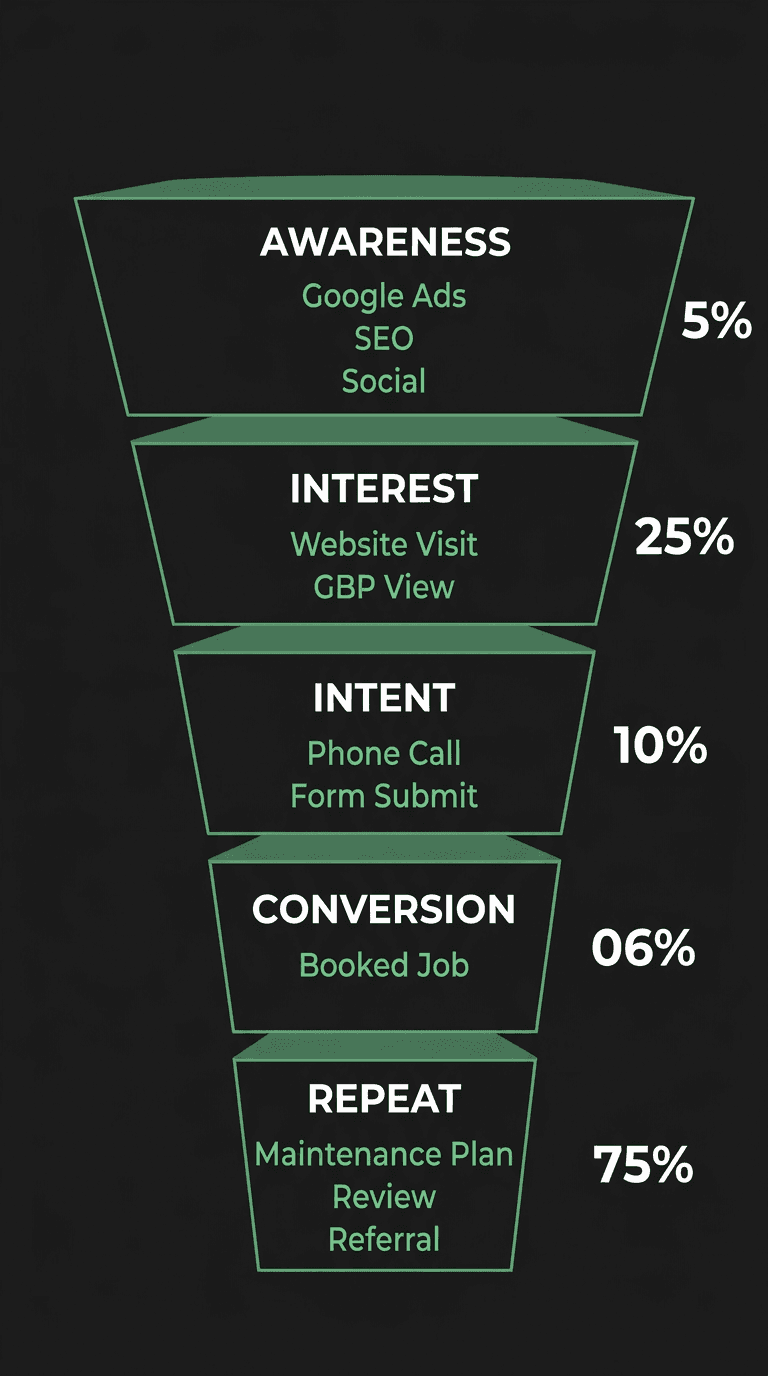
Maintenance Plans: The Lead Generation Flywheel
Maintenance plan memberships are the most underutilized asset in HVAC lead generation. A customer on your maintenance plan calls you first for every repair and replacement. They're 3-4x more likely to book than a cold lead. And at $150-$300/year per household, they create predictable recurring revenue that smooths out seasonal cash flow volatility.
$150-$300
avg annual maintenance plan value
3-4x
higher booking rate vs cold leads
50-70%
maintenance plan close rate
5+ yrs
avg customer retention on plans
8) Measuring Lead Quality & ROI
Generating leads is only half the equation. The other half is knowing which leads are worth chasing and which channels are delivering profitable jobs — not just call volume. Most HVAC companies track "leads" without differentiating between a $200 repair call and a $12,000 system replacement. That gap makes it impossible to allocate budget intelligently.
The Metrics That Actually Matter
Cost Per Lead (CPL) by Channel
Break CPL down by source: Google Ads, LSAs, organic SEO, referrals. A channel with a $60 CPL might be better value than one with a $20 CPL if it generates replacement leads instead of repair calls.
Cost Per Booked Job (CPBJ)
CPL divided by your close rate. A $50 lead with a 30% close rate costs $167 per booked job. A $30 aggregator lead with a 7% close rate costs $429 per booked job. CPBJ reveals the true channel cost.
Revenue Per Lead Source
Tag every job in your CRM with its lead source. Calculate average job value by channel. Google Ads emergency campaigns may have a higher CPL but also a higher average job value than maintenance tune-up campaigns.
Return on Ad Spend (ROAS)
Revenue generated divided by channel cost. Target 5x minimum for paid channels. SEO's ROAS compounding over time often reaches 8-12x once rankings are established. See our HVAC marketing metrics guide for the full framework.
The Lead Aggregator Trap
Services like Angi, HomeAdvisor, and Thumbtack sell the same lead to 3-5 competing HVAC companies simultaneously. You're paying $15-$40 per lead, but so are 2-4 of your competitors. Close rates on shared leads average 5-10% because homeowners often just pick whoever calls first. Calculate your real CPBJ on aggregator leads before assuming they're cheaper than exclusive channels. At a $25 CPL and 7% close rate, you're paying $357 per booked job — more than many Google Ads campaigns.
Tracking Stack for HVAC Lead Generation
- Call tracking (CallRail): Assign unique numbers to each marketing channel. Dynamic number insertion tracks calls by the source page, not just the channel.
- Google Analytics 4: Track form submissions and click-to-call events as conversions. Connect to Google Ads for in-platform optimization.
- CRM tagging: Tag every lead with its source in Housecall Pro, ServiceTitan, or Jobber. This is the only way to track revenue — not just lead count — by channel. See our HVAC CRM comparison to find the right tool.
- LSA dashboard: Review every lead weekly. Dispute invalid leads within 30 days for a credit. Export lead data monthly for your ROAS calculation.
- Monthly reporting: Combine data from all sources into a single spreadsheet: leads, CPL, close rate, CPBJ, and revenue per channel. Review it on the first Monday of each month.
If you'd like expert help setting up this tracking stack and managing your lead generation campaigns, our Google Ads management service includes full tracking setup and monthly reporting. See also our HVAC case study showing how we generated $54K in new revenue for a Tampa HVAC company in six months.
Frequently Asked Questions
How much does an HVAC lead cost?
HVAC lead costs vary by source: Google Ads leads average $30-$80 for repair and $50-$120 for system replacement. LSA leads run $20-$50. Organic SEO leads are free after initial investment. Shared leads from aggregators cost $15-$40 but close at 5-10% vs 25-35% for exclusive leads.
What is the best way to generate HVAC leads?
The most reliable HVAC lead generation combines Google Ads for immediate high-intent leads, local SEO for long-term organic traffic, and LSAs for cost-effective calls. Add a conversion-optimized website and active review management. Companies using all channels see 3-5x more leads than single-channel approaches.
How many leads should an HVAC company generate per month?
A healthy HVAC company should generate 40-80 leads per month per service crew. Expect a 25-35% close rate on qualified leads. So if you need 15 jobs per month, aim for 45-60 qualified leads. During peak season, aim higher to account for the increase in tire-kicker inquiries.
How do I get more HVAC leads in the slow season?
Run Google Ads targeting maintenance and tune-up keywords. Promote maintenance plan memberships. Target off-season services (heating tune-ups in fall, AC tune-ups in spring). Send email campaigns to your existing customer base. Adjust ad messaging to create urgency with seasonal angles.
The Bottom Line
The HVAC companies with the fullest schedules aren't necessarily the best technically — they're the ones with the most consistent lead generation systems. Google Ads and LSAs fill the schedule today. Local SEO and referral systems fill it six months from now, at a fraction of the cost. And a conversion-optimized website ensures you don't waste the traffic you've paid to acquire.
Start by auditing your current channels: What's your CPL by source? What's your close rate? Are you tracking revenue back to each lead channel? If those numbers aren't clear, the first step isn't spending more — it's setting up the measurement infrastructure to spend smarter.
If you want a second set of eyes on your lead generation setup — including a channel-by-channel breakdown of what's working and what's leaking budget — we offer a free HVAC marketing audit that covers your website conversion rate, Google Ads structure, LSA performance, and local SEO footprint. No obligation, no pitch — just a clear picture of where you stand and what to fix first.
For more on the HVAC industry marketing landscape and how to compete in your specific market, our HVAC industry page covers the full picture from GBP to paid search.