
$3-5
Revenue per $1 spent on digital marketing
97%
Consumers who search online for local services
76%
Local mobile searches that call within 24 hrs
5-10%
Recommended marketing spend as % of revenue
HVAC is a high-intent, high-ticket service business — when someone's AC fails on a 95-degree afternoon, they are not browsing. They are searching, clicking, and calling the first company that looks credible. That moment is where digital marketing either wins or loses. This guide covers every channel that matters, how they work together, and exactly how to allocate your budget across all of them. Use the links throughout to go deeper on any specific topic.
1) The HVAC Marketing Landscape in 2026
HVAC marketing has changed more in the past five years than in the previous twenty. Three forces are reshaping how homeowners find and hire HVAC contractors:
Mobile-First Searches
Over 70% of HVAC searches happen on a smartphone. If your website isn't fast and mobile-optimized, you are losing leads before they ever reach your phone number.
Google's Local Ecosystem
The Map Pack, Local Services Ads (LSAs), and organic results all appear on the same page. Owning multiple positions — especially the top three — dramatically increases call volume.
Trust Before the Click
Review count and star rating are now visible before a homeowner even visits your website. Companies with fewer than 25 reviews or below 4.5 stars lose leads silently — the prospect just clicks on a competitor.
The good news: most HVAC companies are still running on referrals, a basic website, and maybe some Facebook posts. The bar for digital dominance in most local markets is not that high. A well-executed strategy across the five core channels below will put you ahead of 90% of your competition.
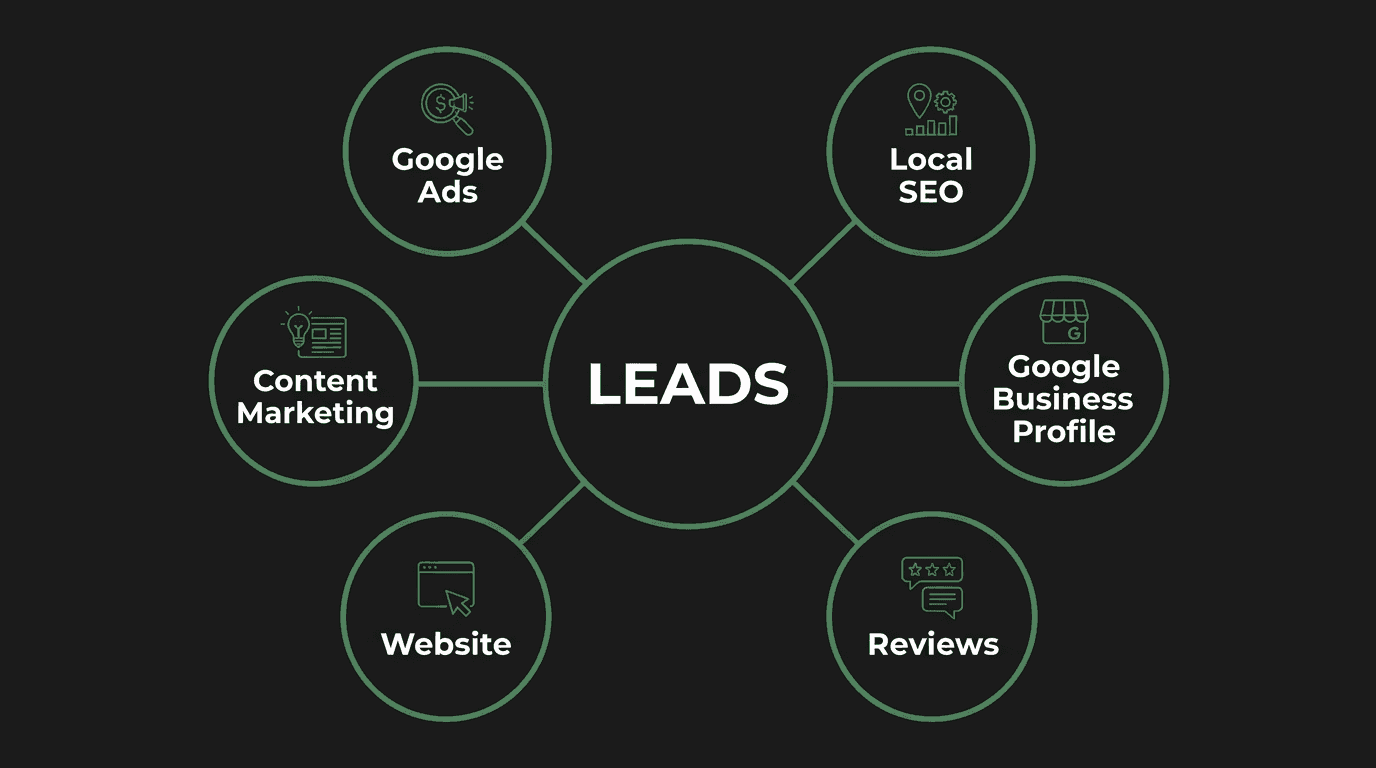
The Five Core Channels
- 1.Google Ads — Immediate paid visibility for high-intent searches. Best for fast lead generation.
- 2.Local SEO + Map Pack — Long-term organic visibility in the 3-pack and local search results.
- 3.Google Business Profile — The hub of your local presence. Affects calls, directions, and Map Pack ranking.
- 4.Reputation Management — Your review count and rating are trust signals that convert browsers into callers.
- 5.Website & Conversion — The landing point for every other channel. A slow or confusing site kills your ROI from all other investments.
For a comprehensive look at HVAC-specific marketing opportunities in your region, see our HVAC industry overview and our companion piece on HVAC lead generation strategies.
2) Your HVAC Website: The Foundation
Every dollar you spend on Google Ads, SEO, or any other channel sends traffic to your website. If that website is slow, confusing, or doesn't make it easy to call you, you are paying to send leads to your competitors. The website is not a marketing channel — it is the foundation everything else is built on.
Non-Negotiable Elements
- Phone number in the header, clickable on mobile
- Load time under 3 seconds on mobile (check PageSpeed Insights)
- Clear CTAs: "Call Now," "Get a Free Estimate," "Schedule Service"
- Dedicated pages for each service (AC repair, heating, installation)
- Service area pages for every city you target
- Trust signals: license number, insurance, years in business
Conversion Killers to Avoid
- xSlow load times — each additional second drops conversions by ~7%
- xNo phone number above the fold on mobile
- xGeneric "Welcome to our website" hero — no clear value proposition
- xContact form as the only conversion option (no phone or chat)
- xNo social proof — reviews, certifications, or customer count
Your website is your highest-leverage asset
For a detailed audit of what makes an HVAC website lose leads — and exactly what to fix — read our guide on HVAC website design: 7 signs your site is losing leads. If you're ready to rebuild, see our website development service for HVAC companies.
3) Google Ads for HVAC Companies
Google Ads is the fastest path to leads for HVAC companies. While SEO takes months to build, Google Ads can put your business in front of homeowners searching "AC repair near me" within days of launching a campaign. The tradeoff: you pay per click, and HVAC keywords are among the most expensive in local advertising.
$8-$35
Average CPC for HVAC keywords
$30-$80
Typical cost per lead
2-4%
Average click-through rate
90 days
Time to optimize campaigns
The Two Types of Google Ads for HVAC
Local Services Ads (LSAs)
Pay Per LeadAppear above traditional search ads. You pay per verified lead, not per click. Require the Google Guaranteed badge, which adds a trust signal that boosts conversions.
- Highest position on the page
- Pay only when a customer calls or messages
- Google Guaranteed badge builds trust
Search Ads (PPC)
Pay Per ClickTraditional keyword-based ads. Appear below LSAs but above organic results. More control over targeting, ad copy, and landing page experience.
- Full control over keywords and bids
- Custom landing pages boost conversion rates
- Granular audience and location targeting
Run both, not one or the other
HVAC Campaign Structure That Works
Emergency & Repair Campaigns
Highest intent, highest CPC. Target 'AC repair near me,' 'furnace not working,' 'emergency HVAC.' These callers need service today and have the highest close rates. Budget 40-50% of your Search Ads spend here.
Installation & Replacement Campaigns
Lower search volume but much higher job value ($5K-$10K). Target 'AC replacement,' 'new HVAC system,' 'furnace installation.' These leads take longer to close but have excellent ROAS.
Maintenance & Tune-Up Campaigns
Lower CPC, lower close rate, but builds recurring revenue. Target 'HVAC tune-up,' 'AC maintenance,' 'HVAC service plan.' Use these to fill shoulder season gaps and build your maintenance customer base.
Brand Defense Campaign
Bid on your own company name. Prevents competitors from poaching branded searches. CPCs are low (often under $1) and conversion rates are extremely high.
For a complete walkthrough of setting up your first campaign — including keyword selection, match types, negative keywords, and conversion tracking — read our Google Ads for HVAC campaign checklist. For budget guidance, see our breakdown of Google Ads budget recommendations for HVAC. If you're comparing ad formats, our LSAs vs Google Search Ads guide breaks down the differences.
Managing Google Ads: Agency vs. DIY
Pros
Cons
For help choosing the right paid search partner, read our guide on how to choose an HVAC PPC agency. If you're interested in getting the Google Guaranteed badge for LSAs, see how to become Google Guaranteed.
4) Local SEO & Map Pack Strategy
Local SEO is how you earn organic visibility in Google's Map Pack (the three local business listings that appear with a map) and in regular organic search results below ads. Unlike Google Ads, local SEO does not cost per click — once you rank, traffic is free. The tradeoff is time: it typically takes 6-12 months to see meaningful results.
| Google Ads | Local SEO | |
|---|---|---|
| Time to results | Days | 6-12 months |
| Cost per lead | $30-$80 | $5-$20 (long-term) |
| Traffic stops when... | Budget runs out | Rankings drop |
| Compounding value | No | Yes |
| Control level | High | Medium |
| Best for | Immediate leads | Long-term growth |
How the Map Pack Works
Google's Map Pack shows three local businesses for location-based searches. Factors that determine who appears include:
Proximity
How close your business address is to the searcher's location. Companies with a physical office in a city rank more easily for that city. Service-area businesses (SABs) that hide their address have a harder time ranking in the Map Pack.
Relevance
Does your Google Business Profile, website, and citations accurately describe what you do? Keyword-optimized GBP descriptions, service categories, and consistent NAP (name, address, phone) across the web all signal relevance.
Prominence
How well-known is your business online? Review count and quality, backlinks from local directories, website authority, and overall web presence all feed into prominence. This is where consistent marketing compounds over time.
On-Page SEO for HVAC
- Create individual service pages for AC repair, heating, installation, maintenance, and any other service — each targeting specific keywords
- Build city/service area pages: "AC Repair in [City]" for each city you serve
- Optimize title tags and meta descriptions with local keywords
- Embed a Google Map on your contact page
- Build schema markup: LocalBusiness, Service, and FAQ schemas on relevant pages
- Earn backlinks from local directories, HVAC associations, and supplier websites
- Publish location-relevant content that addresses regional HVAC concerns
The compound effect of SEO
Our SEO service for HVAC companies includes on-page optimization, local citation building, and content strategy tailored to your market and service area.
5) Google Business Profile Mastery
Your Google Business Profile (GBP) is the most important free marketing asset an HVAC company has. It controls what appears when someone searches your company name, and it determines whether you appear in the Map Pack. Most HVAC companies have a GBP but treat it like a set-and-forget listing. The ones that actively manage it get dramatically more calls.
Optimization Checklist
- Business name matches exactly what's on your website and truck
- Primary category: "HVAC Contractor" — add secondary categories for heating, cooling, etc.
- Phone number is local (not an 800 number) and matches your website
- Service area covers every city you actually serve
- Business description includes primary keywords naturally
- Services section lists every service with descriptions and prices where possible
- Photos: exterior, interior, team, equipment — minimum 20 photos
- Hours are accurate and include holiday hours
- Q&A section seeded with your most common customer questions
- Posts published at least twice per month
Why GBP Posts Matter
GBP posts appear in your Knowledge Panel (the sidebar that shows when someone searches your company name) and signal activity to Google's algorithm. Regular posting shows Google your profile is maintained and can improve your Map Pack ranking over time.
Post ideas that work for HVAC companies:
- Seasonal tips ("Time to schedule your spring AC tune-up")
- Promotions and financing offers
- New equipment or service announcements
- Behind-the-scenes tech photos with captions
- Customer success stories (with permission)
For a complete step-by-step guide to optimizing every section of your profile, see our deep-dive on how to optimize your Google Business Profile for HVAC.
6) Reputation & Review Management
Reviews are visible before a prospect clicks anything. A company with 150 reviews at 4.8 stars and a company with 12 reviews at 4.1 stars are competing for the same click — and the first one wins almost every time. Review management is not optional; it is a core part of HVAC marketing.
93%
Consumers influenced by online reviews
4.5+
Star rating threshold to be competitive
25+
Reviews needed for Map Pack credibility
7 days
Ideal window to request a review after service
Building a Review Generation System
Automate the Ask
Set up automated SMS or email review requests to trigger 24-48 hours after a job is closed. Manual requests get forgotten; automation ensures every customer gets the ask. Most CRMs and field service platforms have this built in.
Make It One Tap
Send a direct link to your Google review form — not your homepage or a page they have to navigate. Every extra step drops completion rates significantly. The easier you make it, the more reviews you get.
Respond to Every Review
Google rewards engagement. Respond to positive reviews with a brief, genuine thank-you. Respond to negative reviews professionally — your response is public and prospective customers are reading it to see how you handle problems.
Monitor Across Platforms
Google is the priority, but also monitor Yelp, Angi, HomeAdvisor, and Facebook. A bad review cluster on any platform can suppress leads. Set up alerts so you see new reviews within 24 hours.
Reviews compound like interest
For a detailed playbook on automating your review requests and handling negative reviews, see our guide on automating Google review requests for HVAC companies.
7) Content Marketing Strategy
Content marketing for HVAC is not blogging for its own sake — it is creating pages and articles that rank for informational searches homeowners make before they need service. "How long does an AC unit last?" "Why is my furnace making a banging noise?" "When should I replace vs repair my AC?" These are questions your future customers are already asking Google.
Content Types That Work
- Symptom guides: "Why is my AC not cooling?"
- Cost guides: "How much does AC replacement cost in [City]?"
- Comparison posts: "Repair vs replace your AC"
- Seasonal prep: "HVAC maintenance checklist for summer"
- Brand comparisons: "Carrier vs Trane: which is better?"
- FAQ pages that target long-tail searches
What to Avoid
- xGeneric "HVAC tips" articles with no local relevance
- xCopying content from manufacturer websites (duplicate content penalty)
- xPublishing and abandoning — content needs internal links and updates
- xTargeting keywords with no local search intent
The right technology stack makes content creation and publishing more efficient. See our guides on the simple tech stack we recommend for HVAC companies and the best CRMs for HVAC contractors to build the operational foundation that supports your marketing.
8) Seasonal Marketing Calendar
HVAC demand is seasonal by nature. The companies that win are the ones who plan their marketing around the calendar — ramping spend before peak seasons, running promotions during slow months, and staying visible year-round instead of only adverting when the phone stops ringing.
January – February: Heating Season Peak
Q1Focus on furnace repair, heating emergencies, and heating system replacements. Google Ads should be weighted toward heating keywords. Send email campaigns to existing customers for winter tune-up specials. This is also a good time to plan spring campaigns and ensure your AC-related content and landing pages are optimized before the spring rush.
March – April: Spring Ramp-Up
Q2 StartShift ad spend toward AC maintenance and spring tune-up campaigns. Run maintenance plan promotions — homeowners are thinking about getting ready for summer. Publish seasonal content: 'Spring HVAC checklist,' 'Is your AC ready for summer?' Lower competition means lower CPCs, so this is a high-efficiency window for Google Ads.
May – June: Pre-Peak Surge
Pre-SummerIncrease Google Ads budgets 20-30% ahead of the summer heat. Competition is rising fast — get in early before CPCs spike with the first heat wave. Double down on AC repair, emergency AC, and installation keywords. Push financing offers for AC replacements. This is the window to capture replacement jobs before homeowners get stuck in the heat and panic-buy.
July – August: Peak Season
PeakMaximum Google Ads spend. Every available impression matters. Ensure your answering system is running at full capacity — missed calls during peak season are extremely expensive. Emergency AC keywords will have the highest CPCs of the year but also the best ROAS. Run 24/7 scheduling and same-day service offers in your ads to differentiate from competitors.
September – October: Fall Transition
Q3 EndWind down summer AC campaigns and shift toward fall maintenance and early heating tune-ups. This is a great period to re-engage your customer list with fall checkup promotions. Competition drops and CPCs fall — use this lower-cost window to push maintenance plans, which generate recurring revenue through the winter.
November – December: Heating Ramp
Q4Heating season begins. Ramp furnace repair and heating emergency campaigns. Black Friday and year-end promotions can work well for financing offers on replacement systems. Capture customers who avoided fixing their heating system in fall and are now running the heat for the first time. Year-end is also the time to review annual marketing performance and set next year's budget.
Slow seasons don't have to mean slow revenue. Our guide on HVAC slow season marketing strategies covers specific tactics to keep leads flowing in spring and fall when demand dips.
9) Marketing Budget Allocation
The most common budget question: "how much should I spend?" The answer starts with a percentage of revenue, then gets allocated across channels based on your growth stage. Here is a framework that works for HVAC companies at different revenue levels.
$500K Revenue
$25K-$50K/yr
Focus on Google Ads and GBP. Website already done. SEO starts now.
$1M Revenue
$50K-$100K/yr
Full channel mix: Ads, SEO, content, reputation management, website optimization.
$3M+ Revenue
$150K-$300K/yr
Aggressive multi-city expansion. Agency management. Full content operation.
Recommended Channel Allocation
| Starter ($2K/mo) | Growth ($5K/mo) | Scale ($10K/mo) | |
|---|---|---|---|
| Google Ads | 60% ($1,200) | 45% ($2,250) | 40% ($4,000) |
| SEO & Content | 20% ($400) | 25% ($1,250) | 25% ($2,500) |
| Website | 10% ($200) | 10% ($500) | 10% ($1,000) |
| Reputation Mgmt | 5% ($100) | 10% ($500) | 10% ($1,000) |
| Other (Social, etc.) | 5% ($100) | 10% ($500) | 15% ($1,500) |
Start weighted toward Ads, shift toward SEO over time
Never go dark to save money
Knowing your numbers is the foundation of smart budget decisions. See our guide on marketing metrics every HVAC contractor must track to understand which KPIs tell you whether your spend is working. For agency options, see our comparison of how to hire the right HVAC marketing agency.
Frequently Asked Questions
How much should an HVAC company spend on marketing?
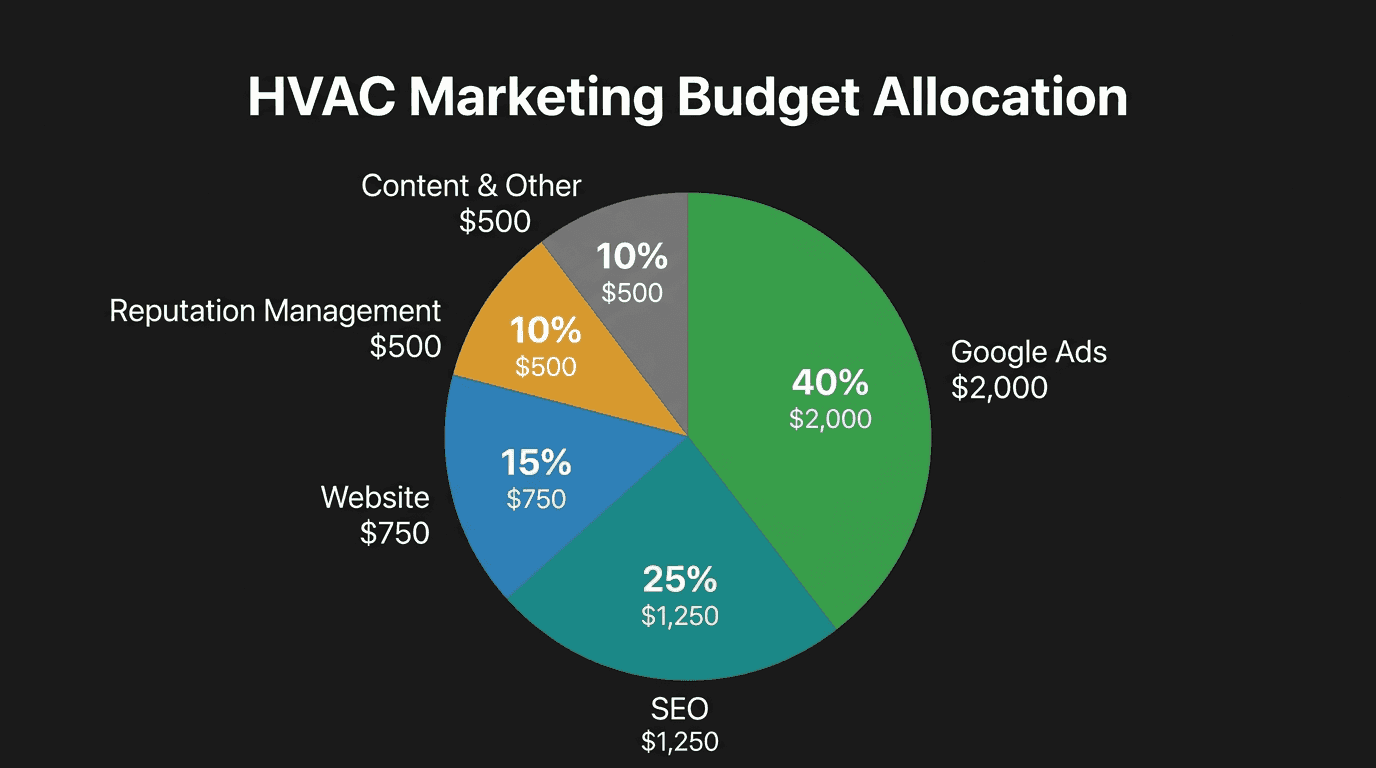
HVAC companies should invest 5-10% of revenue in marketing. A $1M company should budget $50K-$100K annually. Allocate roughly 40% to Google Ads, 25% to SEO, 15% to website, 10% to reputation management, and 10% to content and other channels. Adjust based on seasonal demand.
What is the best marketing strategy for HVAC?
The most effective HVAC marketing strategy combines Google Ads for immediate leads, local SEO for long-term organic traffic, and a conversion-optimized website with strong CTAs. Add seasonal campaign planning and active review management for a complete system that generates consistent leads year-round.
How do HVAC companies get more leads?
Start with Google Ads targeting high-intent searches like 'AC repair near me.' Optimize your Google Business Profile for Map Pack visibility. Build a fast, mobile-first website with clear CTAs. Implement a review generation system. Then invest in SEO for compounding organic traffic over time.
Is digital marketing worth it for HVAC companies?
Absolutely. The average HVAC company generates $3-5 in revenue for every $1 spent on digital marketing. Google Ads deliver immediate leads, SEO builds long-term organic traffic, and a professional website converts more visitors into calls. The companies that invest in digital marketing consistently outgrow those that rely solely on referrals.
The Bottom Line
HVAC marketing is not complicated — but it requires doing several things consistently and well. Start with a fast, conversion-optimized website. Run Google Ads targeting your highest-intent searches. Claim and fully optimize your Google Business Profile. Build a review generation system that runs automatically. Then invest in SEO for the organic traffic that makes every lead cheaper over time.
The companies that grow fastest are not running the most channels — they are executing the core channels better than everyone else. A well-run Google Ads account, an optimized GBP with 200+ reviews, a 4.8-star rating, and a website that converts at 8% will outperform a company doing every channel poorly. Pick the right channels for your stage, execute them well, track your numbers, and improve every quarter.
If you want an expert second opinion on what's working (and what's not) in your current marketing, we offer a free marketing audit for HVAC companies. We'll review your website, Google Ads, SEO, and GBP and give you a clear picture of your highest-leverage opportunities. See our HVAC case study to see what a full digital marketing strategy looks like in practice, or explore our Google Ads and SEO services to learn more about how we work.